In 1956, I went into the motorcycle business part-time with the pricey sum of $500.00 as my total capital investment. That was everything I had to risk. I was living in Boise, Idaho, and it was a nice little town in those days. We had roads, yes—but more importantly, we had trails heading straight into the foothills and mountains east of town.
Back then, no one hauled their dirt bike in a pickup. You just rode it from your house to wherever you wanted to go. The mountains were our playground.
Nickolas Gray from Detroit, Michigan, had just become the importer for Maico, a German brand with legendary quality. They built real enduros and scramblers with 250cc engines—exactly what we needed for Idaho riding. Before I came along, the popular bikes were Triumph, BSA, and Harley-Davidson. Big 500cc, 650cc, and 1000cc machines. Fine motorcycles, but you needed real skill to ride those big bikes in the dirt.
Most anyone, though, could have fun on a 250cc and develop skill as a side effect.
I understood that.
Very soon, I had sold so many Maicos that I had to quit my day job working on cars and become a full-time motorcycle dealer. I rented an abandoned flower shop, put up a sign, and just like that, I was in business.
By 1958, we had outgrown the flower shop, and, still working from that original $500, I put down a deposit and bought an abandoned service station farther up the street. It had a tall glass front, perfect for a showroom. Behind it was a repair area. That old service station became one of the most exciting motorcycle shops in the Northwest.
Over the years, my store was associated with 30 different motorcycle brands from 9 different countries. I did that because my loyalty was never to a manufacturer. It was always searching for what the rider wanted.
The First Honda Comes to Boise
Here’s something many people don’t realize: I was the first importer of a Honda motorcycle of any kind into the United States. After that, the Honda Company arrived in the USA.
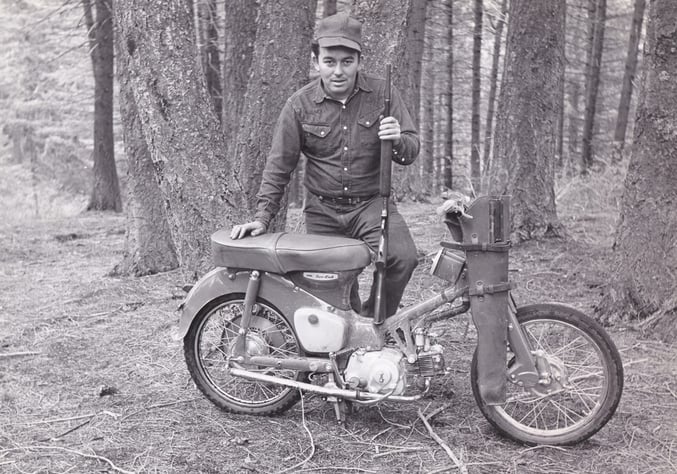
I got the Super Cub, called the C100 or CA100 at the time, which was a scooter-like motorcycle with a pressed-steel frame, 50cc engine, three-speed transmission, and automatic clutch, and 17-inch wire wheels. It was simple, light, reliable, and brilliantly engineered.
There was just one problem. Boise didn’t want city transportation bikes.
In 1960, Boise was still a small town. People didn’t need scooters to commute through traffic. They needed something that could climb a mining road, cross a ranch, or get them into the hills for hunting season.
The Super Cub, as delivered, wasn’t that bike. Most dealers would have said, “It won’t sell here.” I didn’t see it that way.
One of my strengths is my ability to understand what the public wants in a specific product line. When I was a dealer, I understood the customers wanted a trail bike, nd nothing good was available in that category.
The Super Cub was light. It was dependable. It had a low center of gravity. It had a step-through design simplicity. What it lacked was gearing, tires, protection, and rugged purpose. So, I built what the factory had not yet imagined.
In my custom shop at Herco Engineering Co., I began modifying the Super Cub to my trail and ranch specifications. I changed gearing. I added protection, and I had knobby tires built for that size wheel. I configured it for hunting, trail riding, ranch work, and open-road travel.
What I created was not a scooter anymore. It was the first motorcycle-derived ATV. Sales escalated rapidly.
Before long, I was selling more Honda Cubs than all the dealers in the Los Angeles region combined. That caught Honda’s attention. They came to Boise to see what was going on.
I introduced them to my trail bike based on their Super Cub. They studied it carefully. They asked for specifications. They even took one of my bikes home to reverse engineer it.
In no time, Honda had production models of what became the Trail series, culminating in the legendary Trail 90.
The Trail 90 became the biggest-selling adventure bike in the world.
Did I get paid for my extra design-work?
No. I just sold way more motorcycles because I had what the customers were looking for.
I never saw a penny from that innovation itself, only for the results.
But understand this: it was never about the money. It was about making motorcycles better for the rider. It was about recognizing a need and filling it.
And frankly, Honda building my design meant I could sell more bikes with less effort, because the product now arrived already suited for my customers.
That single shift, from city transport to trail utility, helped launch an entire segment of the motorcycle industry.
From that point forward, the evolution was unstoppable:
-
- Trail bikes
- Three-wheelers
- Four-wheelers
- Side-by-sides
All of it traces back to one simple realization: riders wanted machines that could go where the roads ended.
People sometimes forget that the Jeep was the first automotive-derived ATV. Look at how that evolved into today’s off-road trucks and super-duty machines. The same thing happened in motorcycles. A lightweight transportation machine became a utility vehicle. A utility vehicle became a trail platform. That platform became an industry.
What began as a modified 50cc Honda in Boise, Idaho, led to multimillion-dollar windfalls for major manufacturers.

In the annals of motorcycle history, people talk about big names and big factories. But innovation does not always start in Tokyo, Munich, or Milwaukee.
Sometimes it starts in an abandoned flower shop or glass-front service station. Sometimes it starts with $500 and a willingness to see what others overlook.
I did not invent the motorcycle. I did not build the Super Cub, but I understood what the public wanted before the factories did, and when you can see potential inside an existing design, and you are willing to act on it, you can change an industry.
That is the real legacy. Not money. Not fame. Contribution.
And the satisfaction of knowing that somewhere, someone is riding a trail bike today because a dealer in Boise decided a city scooter deserved to climb a mountain.