Video Honda Trail Origin Story Herb Uhl

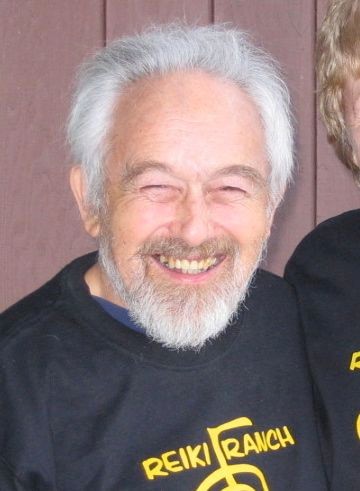
I’m Herb Uhl, let’s start off in Boise Idaho. My wife at that time got hit by a car when she was riding her motorcycle and we got about 800 bucks for the damage. I fixed the motorcycle for a couple of hundred and the other five I put into the motorcycle business.

That was the start of the motorcycle business, 500 bucks. I opened my own dealership. I wanted off-road motorcycles because it was Boise Idaho, and very few people ever rode a motorcycle on the highway except to get to the hills in Boise Idaho at that time.

I wanted off-road motorcycles and so I took on Maico (m-a-i-c-o) and I they had Enduro motorcycles at that time. I know years later, Yamaha thinks they invented the name but Maico Enduros were available in 1955 – 56.

Herco h-e-r-c-o (Herb’s company) engineering was in Garden City, part of Boise. If you’re looking North it’s on the left. Simple as that.

I ordered a motorcycle, and I guess I sold a couple of them. Then the importer, Nicholas Gray, the importer at that time out of Detroit, came to see me, and he offered me motorcycles on consignment, which got me in the business. So, my total investment was $500.00.

You could ride from your house to the hills on a motorcycle without license plates. Nobody paid any attention. That’s what everybody did. Very seldom, anybody ever rode a motorcycle on the road. Well, there were a few road riders but not many.

There were a lot of dirt riders because the foothills were right there and so everybody went to the hills, and that was my interest too, I didn’t care about riding on the road. You can drive on the road, you don’t have to ride on it. And there were lots of old logging roads and old mining roads because there was a lot of mining that went on in that area. So, we explored all those old roads and rode in all kinds of places.

I ordered the first Hondas from Japan. In fact, I think I got the first Hondas that came into the U.S. A guy down in San Diego with the name of Sailor Maine also ordered about the same time. We both went into the motorcycle business.

They were actually off-road motorcycles. There was a little bitty article in Cycle World, I think at that time, that had a picture of this motorcycle. Honda, out of Japan, and everybody was wondering if the thing would be any good if it would be junk, or what it was?

It looked good to me, so I ordered a pair of them. I got them in and sold them almost instantly. I ordered more, and they wouldn’t sell me anymore because they weren’t serious motorcycles. Those were built in their race shop, and they didn’t realize that that’s what we wanted.  They didn’t get the message for several years. They couldn’t understand it because we wanted motorcycles for off-road use.

When they moved to Los Angeles and set up American Honda, I was the first American dealer to contact them. That was when they were in an apartment house out on Sepulveda Boulevard. They were trying to figure out how to set up a distributorship in America. They were up in this big apartment in the apartment house.

The first bikes I got, I forget what the model was, but it wasn’t a series model. As I said, it was special. Then they came out with the CB 71, 72, and of course, the C-100, the Honda Cub. That was a little 50cc, and so as soon as they got set up on Sepulveda with American Honda in their little building front, I went down to see him. I ordered some of the Cubs and they had a little 150 as well, so I ordered some of those 150s, a couple of them, and ordered a couple of CB-72s and two or three Cubs. When they came in at Boise, I looked at those Cubs and wondered how I was ever going to sell them in Boise.

That’s when I started looking at them as, what I could do to them to make them so that people would want them. I got to looking at them and every time I walked by them, I looked down a little more and I decided that they would make a way better trail bike than the tote goats and so forth that people were using at that time.

There was a guy in Boise that built sprockets and had a machine to make sprockets. I ordered a sprocket to stick over the other one as an overlay. Then I ordered knobby tires for them because that would be necessary. It took several months for knobbies to come in for it.

I tried it out in the hills and found out that it actually worked really well, so I started building them and ordered them in. I guess I sold several hundred of them before Honda noticed that I was selling way more Honda Cubs than all of their dealers in the Greater Los Angeles area together. And these were city bikes, where they should have sold there but here I was selling them out in a little town in Idaho.

Jack McCormick from American Honda called and wondered what I was doing to sell all those little cubs because they weren’t moving. I told him to make them into trail bikes and so he said, “Send me one of them, so I can see what you’re doing.”

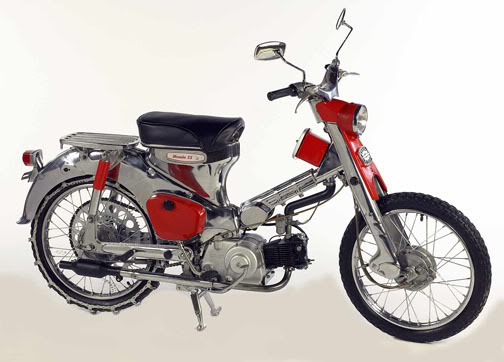
I sent it to him and he looked it over. They rode it around and played with it. Then they sent it on to Japan and told Japan that they wanted the exact same thing as a separate model. That was the start of the Honda Trail Bike. Of course, once Honda started building them, then all the other motorcycle companies copied Honda, and there was trail bike Yamaha, and Kawasaki, and everybody had a little trail bike of some kind. That started the ATV motorcycle business.

I was just selling motorcycles. It was just the way things were, you know, I was just selling lots of motorcycles.

(It didn’t bother you that they took your designs and made their own bike?)

No, really because it didn’t even occur to me that it was a big deal but that actually started the motorcycle-derived ATV. And that’s made the motorcycle companies more money than anything else that’s ever been done to motorcycles. That’s where it started, then the three-wheelers came, and from that then four-wheelers, and now side by sides.

In fact, if it wasn’t for that (Uhl’s trail bike design) the side-by-sides would probably say Chevy, Ford, and RAM instead of Kawasaki or Yamaha. So, that really started the off-road motorcycle business.

Getting to a little lake or something up in the mountains required a horse or a hell of a long walk. They were building little scooters with Briggs and Stratton engines on them with no suspension on either end so that they could go up into those places. They called those things “tote goats” which became a brand the company started up to build those little things. They had a piece of plywood on there with a little padding on it and covering for a seat and so forth.

I looked at that Cub and I said, “This will do a better job than that.” it was simple. Really, really simple. It was just looking at it and seeing another use for this piece of equipment that nobody was covering. There wasn’t anybody covering a proper trail bike, so I built a proper trail bike. Just by modifying that Cub and that’s all that was.

Honda never really understood the trail bike. They still don’t. And that you can tell by what they’ve done. In the first place, they didn’t realize that the seat height on the Cub had a lot to do with its appeal. The first thing they did when they designed their own, after copying mine, was to raise the seat height by about three or four inches. So, they never understood it.

They did finally understand that. Somebody told them they needed a high and low-range gearbox and they did that but they dropped it. That was the only thing that they contributed to the trail bike that really improved it, was a high/low-range gearbox.

This new one doesn’t have it. So, the new one is not a good road bike or a good trail bike. It’s neither one. What it is, is an off-road fun bike. That’s all it is. But if they’d left the high low-range gearbox in it, it would be a really good trail bike.

I made a bigger sprocket because it needed to have a lower range of gearing. I made a big sprocket that slipped on over the original and that made it a high/low-range gearing so that it could be used on the trail and that’s the way we sold them. If they wanted to use them on the road, they simply slip that sprocket off and put the chain down on the original sprocket and away you’d go. That was the main thing.

Then they had a leg shield on it and I took all that off. I took their bigger muffler off and put on a small pipe, again for clearance, and so forth. I moved the shock. The shock had to be moved at the top of the shock to give room for the sprocket to clear. I simply did that, moved the bottom of the shock out to the outside of the swing arm instead of the inside, and that gave clearance. Really, that’s all I had to do. And added the knobby tires.

They already had the trail bike. It was already in that design. They just didn’t know it.

The feedback I got from my customers was the best you can get. They were loving it and they and their friends were coming in and buying them too. Now that’s the best feedback you can get.

Special thanks to Callum Blackmore, Eric Stoothoff, and Adam Bale for helping to get the word out. Maybe someday, someone will make an even better trail bike.
 

From $500 and a Flower Shop to the First Trail Bike Revolution

In 1956, I went into the motorcycle business part-time with the pricey sum of $500.00 as my total capital investment. That was everything I had to risk. I was living in Boise, Idaho, and it was a nice little town in those days. We had roads, yes—but more importantly, we had trails heading straight into the foothills and mountains east of town.

Back then, no one hauled their dirt bike in a pickup. You just rode it from your house to wherever you wanted to go. The mountains were our playground.

Nickolas Gray from Detroit, Michigan, had just become the importer for Maico, a German brand with legendary quality. They built real enduros and scramblers with 250cc engines—exactly what we needed for Idaho riding. Before I came along, the popular bikes were Triumph, BSA, and Harley-Davidson. Big 500cc, 650cc, and 1000cc machines. Fine motorcycles, but you needed real skill to ride those big bikes in the dirt.

Most anyone, though, could have fun on a 250cc and develop skill as a side effect.

I understood that.

Very soon, I had sold so many Maicos that I had to quit my day job working on cars and become a full-time motorcycle dealer. I rented an abandoned flower shop, put up a sign, and just like that, I was in business.

By 1958, we had outgrown the flower shop, and, still working from that original $500, I put down a deposit and bought an abandoned service station farther up the street. It had a tall glass front, perfect for a showroom. Behind it was a repair area. That old service station became one of the most exciting motorcycle shops in the Northwest.

Over the years, my store was associated with 30 different motorcycle brands from 9 different countries. I did that because my loyalty was never to a manufacturer. It was always searching for what the rider wanted.

The First Honda Comes to Boise

Here’s something many people don’t realize: I was the first importer of a Honda motorcycle of any kind into the United States. After that, the Honda Company arrived in the USA.

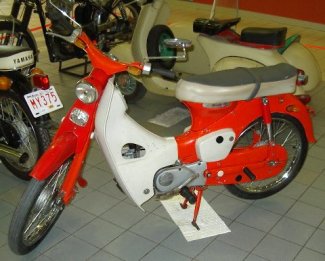
I got the Super Cub, called the C100 or CA100 at the time, which was a scooter-like motorcycle with a pressed-steel frame, 50cc engine, three-speed transmission, and automatic clutch, and 17-inch wire wheels. It was simple, light, reliable, and brilliantly engineered.

There was just one problem. Boise didn’t want city transportation bikes.

In 1960, Boise was still a small town. People didn’t need scooters to commute through traffic. They needed something that could climb a mining road, cross a ranch, or get them into the hills for hunting season.

The Super Cub, as delivered, wasn’t that bike. Most dealers would have said, “It won’t sell here.” I didn’t see it that way.

One of my strengths is my ability to understand what the public wants in a specific product line. When I was a dealer, I understood the customers wanted a trail bike, nd nothing good was available in that category.

The Super Cub was light. It was dependable. It had a low center of gravity. It had a step-through design simplicity. What it lacked was gearing, tires, protection, and rugged purpose. So, I built what the factory had not yet imagined.

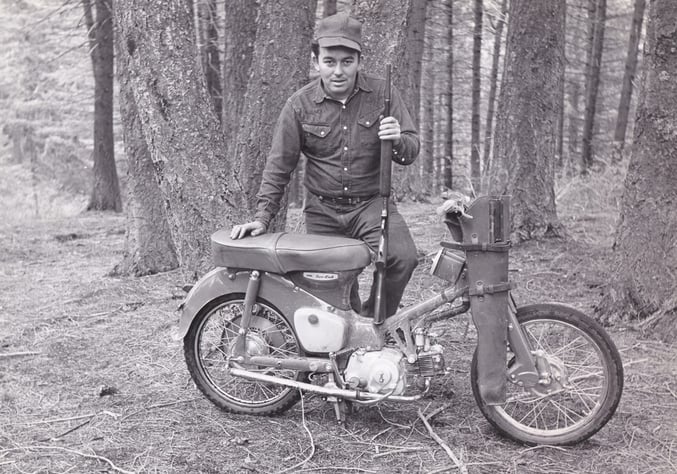
In my custom shop at Herco Engineering Co., I began modifying the Super Cub to my trail and ranch specifications. I changed gearing. I added protection, and I had knobby tires built for that size wheel. I configured it for hunting, trail riding, ranch work, and open-road travel.

What I created was not a scooter anymore. It was the first motorcycle-derived ATV. Sales escalated rapidly.

Before long, I was selling more Honda Cubs than all the dealers in the Los Angeles region combined. That caught Honda’s attention. They came to Boise to see what was going on.

I introduced them to my trail bike based on their Super Cub. They studied it carefully. They asked for specifications. They even took one of my bikes home to reverse engineer it.

In no time, Honda had production models of what became the Trail series, culminating in the legendary Trail 90.

The Trail 90 became the biggest-selling adventure bike in the world.

Did I get paid for my extra design-work?

No. I just sold way more motorcycles because I had what the customers were looking for.

I never saw a penny from that innovation itself, only for the results.

But understand this: it was never about the money. It was about making motorcycles better for the rider. It was about recognizing a need and filling it.

And frankly, Honda building my design meant I could sell more bikes with less effort, because the product now arrived already suited for my customers.

That single shift, from city transport to trail utility, helped launch an entire segment of the motorcycle industry.

From that point forward, the evolution was unstoppable:

    • Trail bikes
    • Three-wheelers
    • Four-wheelers
    • Side-by-sides

All of it traces back to one simple realization: riders wanted machines that could go where the roads ended.

People sometimes forget that the Jeep was the first automotive-derived ATV. Look at how that evolved into today’s off-road trucks and super-duty machines. The same thing happened in motorcycles. A lightweight transportation machine became a utility vehicle. A utility vehicle became a trail platform. That platform became an industry.

What began as a modified 50cc Honda in Boise, Idaho, led to multimillion-dollar windfalls for major manufacturers.

The Best Adventure Bike

In the annals of motorcycle history, people talk about big names and big factories. But innovation does not always start in Tokyo, Munich, or Milwaukee.

Sometimes it starts in an abandoned flower shop or glass-front service station. Sometimes it starts with $500 and a willingness to see what others overlook.

I did not invent the motorcycle. I did not build the Super Cub, but I understood what the public wanted before the factories did, and when you can see potential inside an existing design, and you are willing to act on it, you can change an industry.

That is the real legacy. Not money. Not fame. Contribution.

And the satisfaction of knowing that somewhere, someone is riding a trail bike today because a dealer in Boise decided a city scooter deserved to climb a mountain.


The First ATVs Had Two Wheels

By Damon Marturion

The story of the origin of the ATV starts at Boise Idaho in 1960 where a local motorcycle dealer by the name of Herb Uhl redesigned a small 50cc Honda Cub. It had been built mainly for city transportation.

Rugged Boise Idaho terrain paved the way for the 1960 invention of the Honda trail bike by Herb UhlHerb redesigned it for use on mountain trails and for use on the farms and ranches that covered Idaho’s wide open spaces. As soon as he started converting Them they sold like hot cakes.

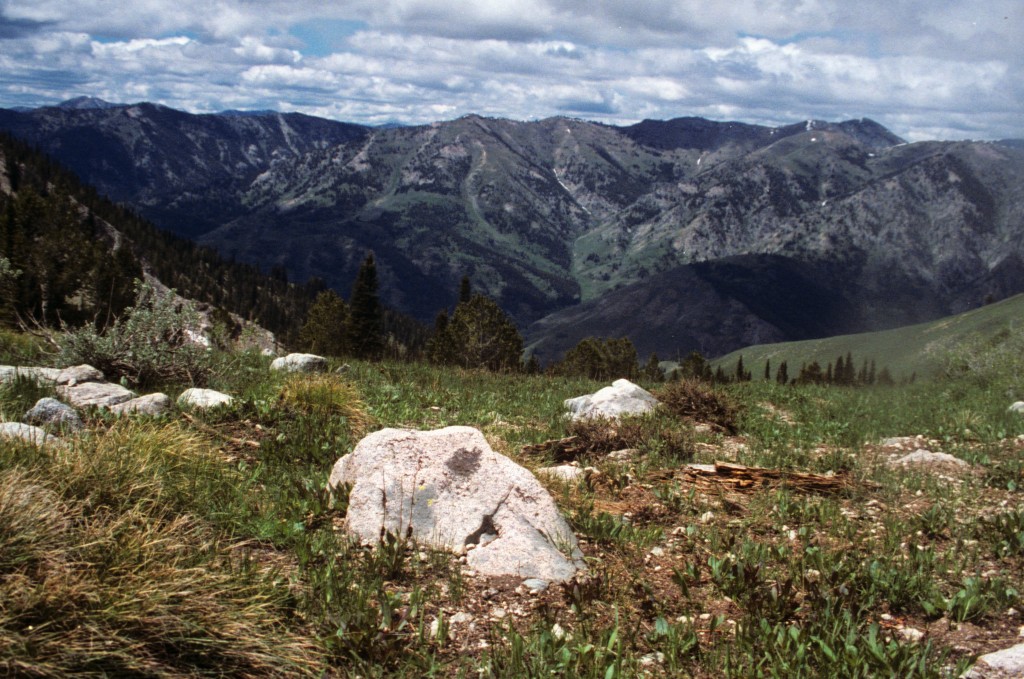
Surrounding the Boise area were thousands of acres of nearly road-less mountains and desert with very few fences. In those days you could climb on your motorcycle in town at your house and within a few minutes you could be on top of one of the foothills of the mountains next to Boise.

From there you could look out over the entire valley clear to the Owyhee Mountains to the west. Seldom did anyone in the area ride their motorcycles on the highway more than a few miles from town.

Most of the bikes were stripped down to short basic fenders & small lights and were equipped with knobby tires to get traction in the dirt. You could call them the beginning of the modern adventure bike.

Herb Uhl inventor of the first ATV Honda trail bikeThat’s what it was like in 1950 when Herb Uhl moved to Idaho from Florida. Herb was a mechanic who’d started his career in a motorcycle shop several years before so he really liked motorcycles.

In Boise Herb was working in an automotive shop on automatic transmissions. There were three motorcycle shops in town at that time; Harley Davidson (Don Gamble) with a couple dirt riders, Triumph (Buzz Chaney) with a lot of fame as a racer with most of the dirt riders, and B.S.A. (Harlan Wood) just back from the service, he was the new dealer in town with a growing group of dirt riders.

Herb used to wander into the shops from time to time but no one had the kind of lightweight bike he wanted so he spent most of his spare time researching the magazines looking for his idea of a proper dirt bike.

He was working at the transmission shop one day when a customer traded in a nearly new All State motorcycle for some transmission work.

Herb’s wife Rosemary was riding the motorcycle one day when another lady in a car turned in front of her. Herb repaired the small damage To the bike and used most of the insurance money to go into the motorcycle business. That was early in 1955.

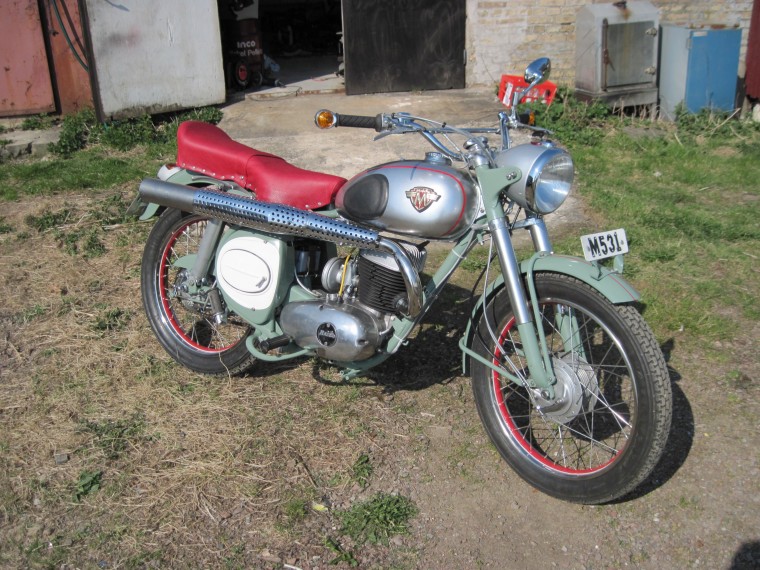
1955 Maico M250 Sports MotorcycleThe brand he chose to handle was Maico. It was built by a German company and was better engineered than the English & American bikes that were available.

The first bikes presented by the US distributor were some surplus units that had been ordered by the Sweedish distributor who ran low on money before they could be delivered. They were perfect for Idaho dirt riders. The machines had been specially built for International off-road competition. All were light weight 250cc high performance 2-stroke machines with knobby tires, special tool kits (because in that type event the rider is required to do all their own maintenance), and even an air bottle (for refilling tires), and a four gallon fuel tank (handy on long trail rides).

It wasn’t long ‘til Nick Gray, the importer, put 10 bikes at a time with Herb on consignment, so the business moved right along. In 1959 Herb saw info in a cycle magazine about a motorcycle company called Honda who would ship bikes from Japan, so he ordered two of the off-road competition models shown in the magazine article.

Herb thought they would probably be pretty crude because the news in those days fed everyone a lot of anti-Japan propaganda. The bikes arrived in a couple of months and they were beautiful. A reorder was put in but they would only sell him production highway bikes and the factory couldn’t understand why he didn’t want them.

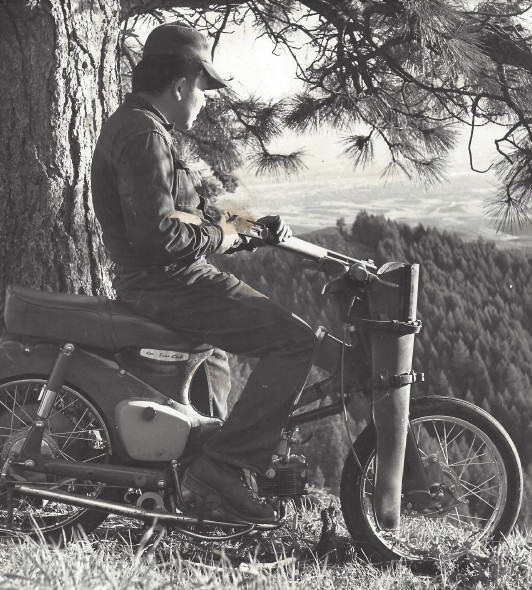
1960 modified Honda Cub for trail and hunting use in Boise Idaho Herb UhlBy 1960 Honda was opening a US branch on Sepulveda Boulevard in Los Angeles and Herb was the first US dealer to visit them.

He signed up for a regular dealership and got a few of their regular bikes to see if they would sell in Boise Idaho.

The people from Japan couldn’t fathom why Herb wanted,  what to them were competition-only machines instead of bikes the public should want.

There was Herb with a bunch of bikes in stock that were designed for the city, and not for the rough country around Boise Idaho.

In the 1960s about the only way to get to any one of the numerous high mountain lakes for instance, was horses and pack animals or walking. Back yard tinkerers were putting lawn mower engines on a little rectangular framework with two small wheels, like a tiny crude scooter without suspension or shocks and a board with upholstery for a seat to try to make mountain travel a little easier.

50cc Honda Cub model CA 100Herb started looking at the little 50cc Honda Cub, model CA-100, from a different point of view. It had all the good stuff it takes to build an excellent all-terrain-vehicle. It was lightweight (about 140 lbs.) with 17 inch wheels like a small motorcycle for stability and the gas tank was under the seat like a scooter.

It had a great Engine a 3 speed transmission with an automatic clutch so no skill was required to ride it. There was a real seat and it sat low enough that almost everyone could touch the ground. The suspension rivaled many large motorcycles of the day with shocks and swing arm suspension both front and rear and finally it went a long way with a tank full of gas.

The first thing Herb did was order in knobby tires. While he awaited their arrival he had a large 72 tooth rear sprocket made that slipped right over and bolted to the original road sprocket to slow it down enough for trail, farm and ranch use.

Next, things were slimmed down so it would easily go between trees and rocks. A skid plate was built to protect the engine and a less bulky muffler was used. It worked really well all over the mountains around Boise.

Herb had converted and sold a couple of hundred machines when Jack McCormick national sales manager for American Honda noticed that Herb was selling more Honda Cubs than all the dealers in Los Angeles combined.

The story of American Honda’s rise to prominence is highlighted in Aaron P. Frank’s book, Honda Motorcycles as told by Jack McCormack.

1962 Honda Cub Trail BikeSo there you have it the first ATVs had two wheels and were designed in the small town of Boise Idaho by Herb Uhl.

As soon as the other motorcycle manufacturers in Japan saw what Honda was doing they each came out with their own version of the two-wheeled ATV.

We’re all led to believe one person can’t make a difference.

Herb’s ability to think a little bit outside the box caused several hundred thousand practical fun machines to be sold all over the world. All this activity helped the Honda Cub become the largest selling vehicle ever made (over 26 million sold). A true Swiss Army knife of motorcycles.

A few years later came the 3-wheeled ATV followed closely by the 4-wheelers leading directly to today’s side by sides.

Most campers and hunters have an ATV or two, and now you see one model or another, and sometimes several on almost every farm and ranch all over the world.

American Honda’s Rise to Prominence starts in Idaho