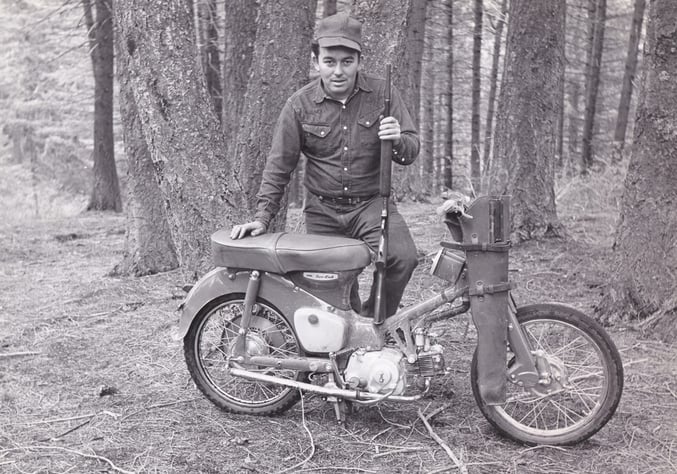
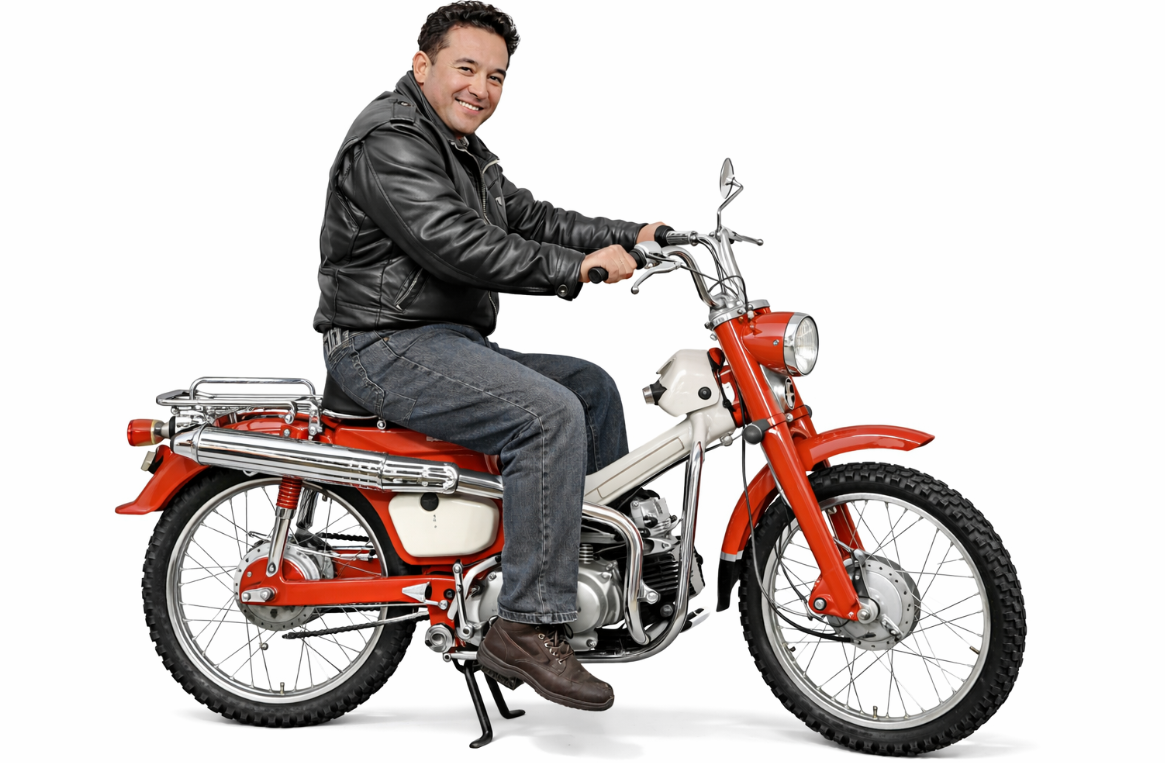
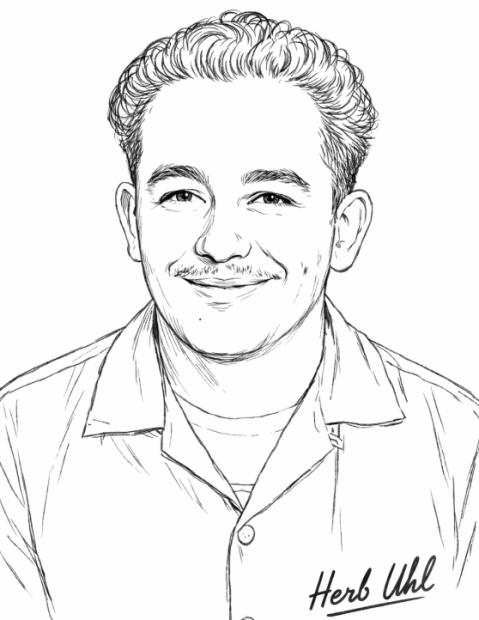
Herb Uhl helped shape modern motorcycling in ways most riders benefit from—but few know. In 1960, working from a small motorcycle shop in Boise, Idaho, Herb developed what would become the Honda Trail Bike—widely regarded as the first motorcycle-based recreational off-road vehicle. That idea didn’t just create a product. It created a movement.
How would you like to help Herb Uhl get into the AMA Motorcycle Hall of Fame? The AMA Motorcycle Hall of Fame accepts nominations from the public.
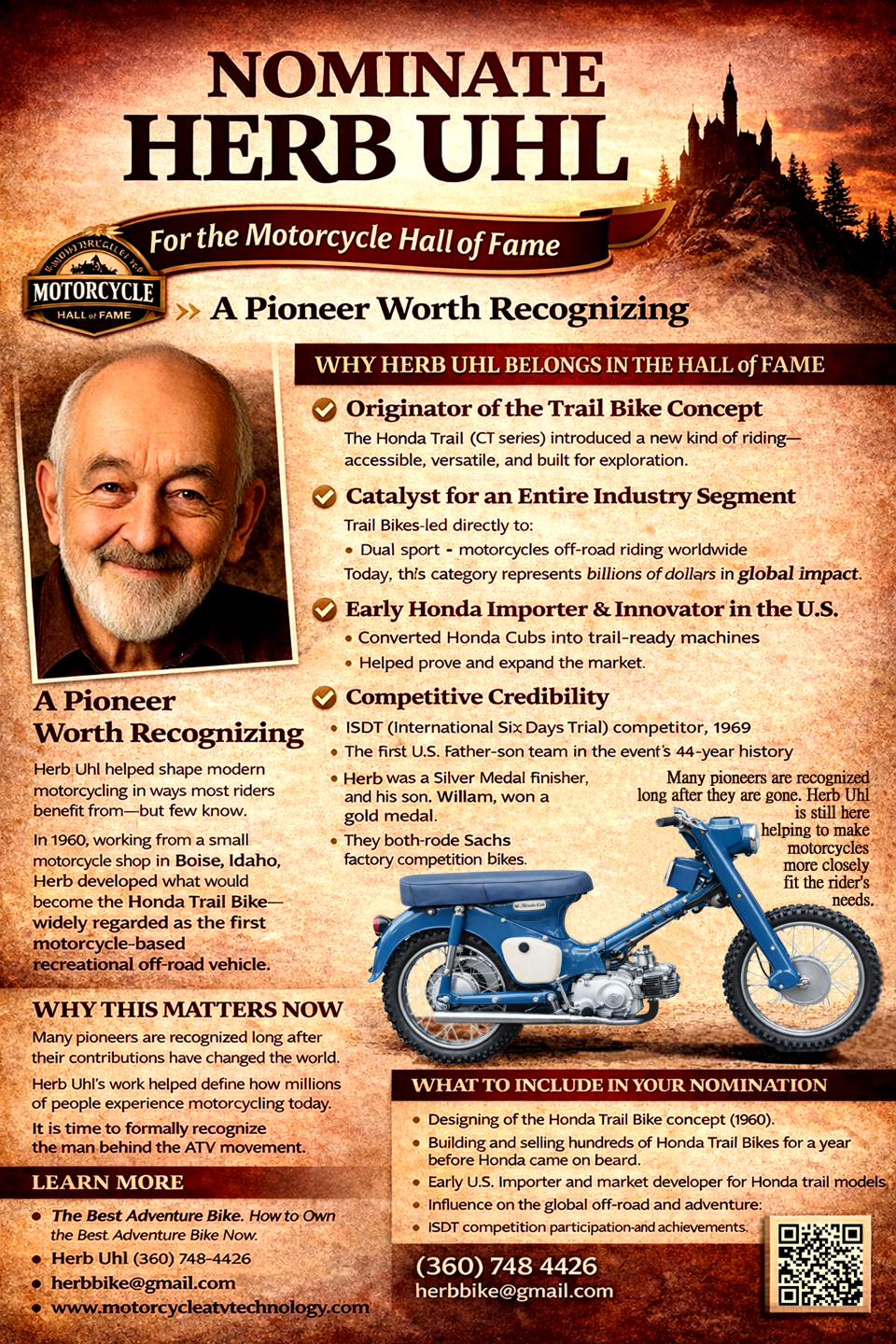
WHY HERB UHL BELONGS IN THE HALL OF FAME
✔ Originator of the Trail Bike Concept
The Honda Trail 50 (CT series) introduced a new kind of riding—accessible, versatile, and built for exploration.
✔ Catalyst for an Entire Industry Segment
Trail bikes led directly to:
Recreational + business off-road riding worldwide
Today, this category represents billions of dollars in global impact.
✔ Early Honda Importer & Innovator in the U.S.
Before factory production:
Converted Honda Cubs into trail-ready machines
Helped prove and expand the market
✔ Competitive Credibility
ISDT (International Six Days Trial) competitor, 1969 at age 40
The first U.S. father-son team in the event’s 44-year history
Herb was a Silver Medal finisher, and his son, William, won a gold medal
They both rode Sachs factory competition bikes
✔ A Lifetime of Contribution
At 97 years old, Herb continues contributing ideas to improve motorcycle design—most recently through his work on practical, rider-centered adventure bikes.
WHY THIS MATTERS NOW
Many pioneers are recognized long after their contributions have changed the world. Herb Uhl’s work helped define how millions of people experience motorcycling today. It is time to formally recognize the man behind the ATV movement.
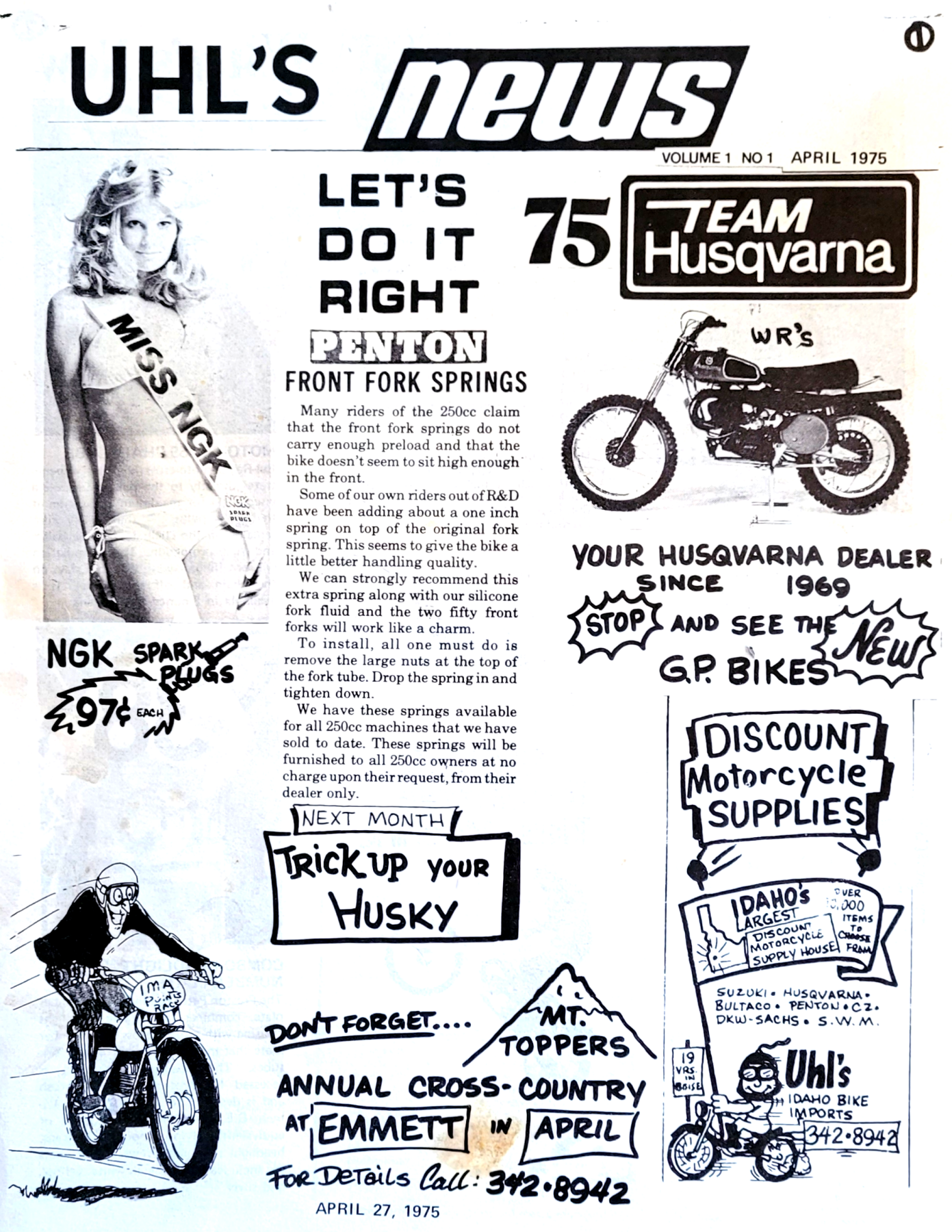
Many riders of the 250cc claim that the front fork springs to not carry enough preload and that the bike doesn’t seem to sit high enough in the front. Some of our own riders out of R&D have been adding about a one inch spring on top of the original fork spring. This seems to give the bike a little better handling quality.
We can strongly recommend this extra spring along with our silicone fork fluid and the two fifty front forks will work like a charm.
To install, all one must do is remove the large nuts at the top of the fork tube. Drop the spring in and tighten down.
We have these springs available for all 250cc machines that we have sold to date. These springs will be furnished to all 250cc owners at no charge upon their request, from their dealer only.
Next Month Trick Up Your Husky
Don’t forget: Mt. Toppers Annual Cross-Country at Emmett in April. For details call: 342-8942.
75 Team Husqvarna Your Husqvarna Dealer Since 1969. Stop and see the new G.P. Bikes
Discount Motorcycle Supplies
Idaho’s largest discount motorcycle supply house. Over 10,000 items to choose from. Suzuki – Husqvarna – Bultaco – Penton – CZ – DKW – Sachs – S.W.M. 19 years in Boise. Uhl’s Idaho Bike Imports
NGK Spark Plugs 97 cents each.
(1)
What’s New
That’s I.T.!
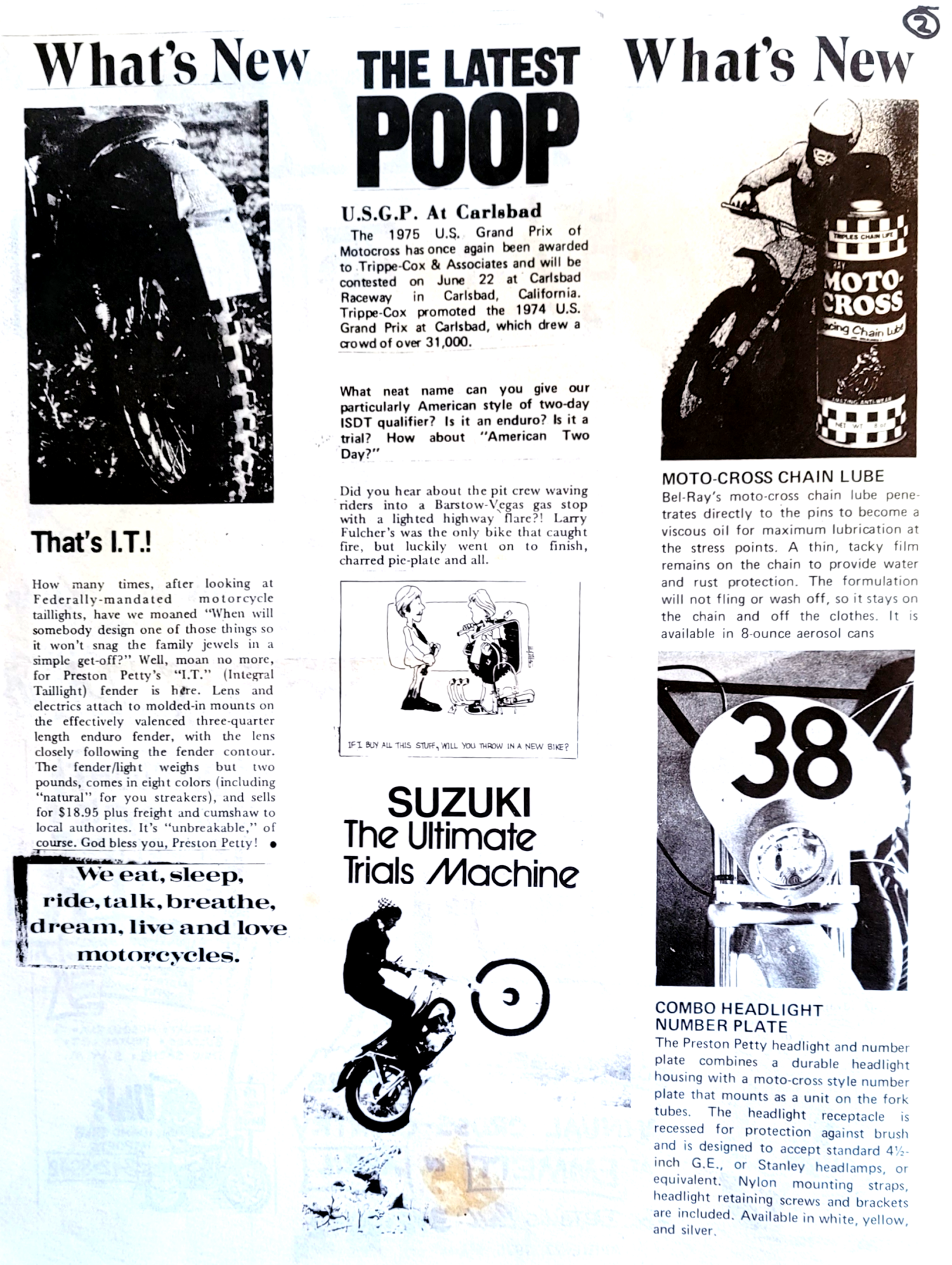
How many times after looking at Federally-mandated motorcycle taillights, have we moaned, “When will somebody design one of those things so it won’t snag the family jewels in a simple get off?” Well, moan no more, for Preston Petty’s “I.T.” (Integral Taillight) fender is here. Lens and electrics attach to molded-in mounts on the effectively valenced trhree quaerter length enduro fender, with the lens closely following the fender contour. The fender/light weight but two pounds, comes in eight colors (including “natural” for you streakers), and sells for $18.95 plus freight and cumshaw to local authorities. It’s “unbreakable” of course. God bless you, Preston Petty!
We eat, sleep, ride, talk, breathe, dream, live and love motorcycles.
The Latest Poop
U.S.G.P. At Carlsbad
The 1975 U.S. Graqnd Prix of Motocross has once again been awarded to Trippe-Cox & Associates and will be contested on June 22 at Carlsbad Raceway in Carlsbad, California. Trippe-Cox promoted the 1974 U.S. Grand Prix at Carlsbad, which drew a crowd of over 31,000.
What neat name can you give our particularly American style of two-day ISDT qualifier? Is it an enduro? Is it a trail? How about “American Two Day?”
Did you hear about the pit crew waving riders into a Barstoe-Vegas gas stop with a lighted highway flare?! Larry Fulcher’s was the only bike that caught fire, but luckily went on to finish, charred pie-plate and all.
Suzuki, the ultimate trails machine.
What’s New
Moto-Cross Chain Lube
Bel-Ray’s moto-cross chain lube penetrates directly to the pins to become a viscous oil for maximum lubrication at the stress points. A thin, tacky film remains on the chain to provide water and rust protection. The formulation will not fling or wash off, so it stays on the chain and off the clothes. It is available in 8-ounces aerosol cans.
Combo Headlight Number Plate
The Preston Petty headlight plate combines a durable headlight housing with a moto-cross style number plate that mounts as a unit on the fork tubes. The headlight receptacle is recessed for protection against brush ande is designed to accept standard 4 ½-inch G.E. or Stanley headlamps, or equivalent. Nylon mounting straps, headlight retaining screws and brackets are included. Available in white, yellow, and silver.
(2)
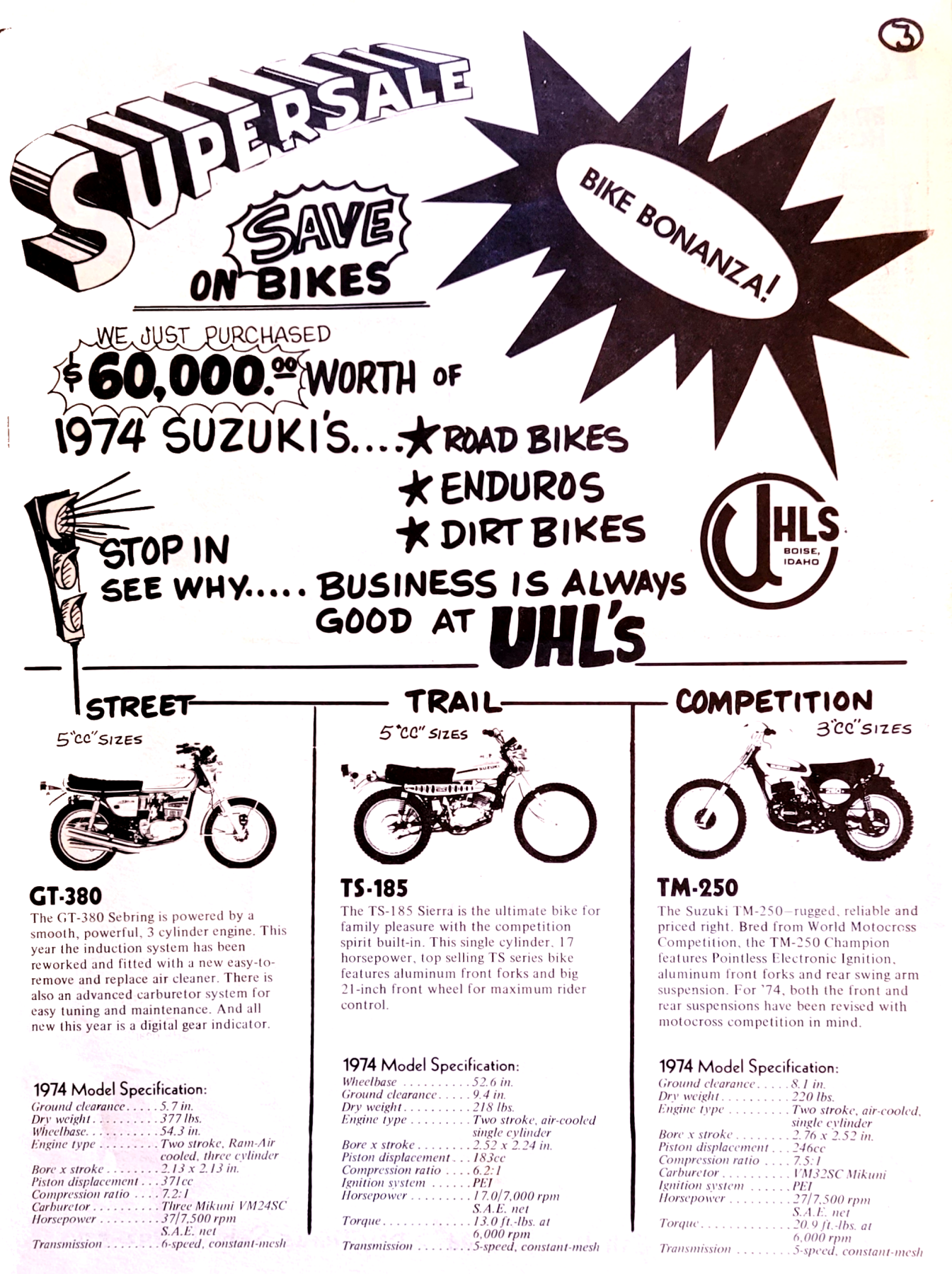
Supersale Bike Bonanza!
Save On Bikes
We just purchased $60,000.00 worth of 1974 Suzukis: Road Bikes – Enduros – Dirt Bikes
Stop in, see why… business is always good at Uhl’s, Boise, Idaho.
Street 5 ”cc” sizes
GT-380 The GT-380 Sebring is powered by a smooth, powerful, 3 cylinder engine. This year the induction system has been reworked and fitted with a new east-to-remove and replace air cleaner. There is also an advanced carburetor system for easy tuning and maintenance. And all new this year is a digital gear indicator.
Trail 5”cc” sizes
TS-185 The TS-185 Sierra is the ultimate bike for family pleasure with the competition spirit built-in. This single cylinder, 17 horsepower, top selling TS series bike features aluminum front forks and big 21-inch front wheel for maximum rider control.
Competition 3”cc” sizes
TM-250 The Suzuki TM-250-rugged, reliable and priced rightBred from World Motocross Competition, the TM-250 Champion features
Pointless Electronic Ignition, aluminum front forks and rear swing arm suspension. For ’74, both the front and rear suspensions have been revised with motocross competition in mind.
(3)
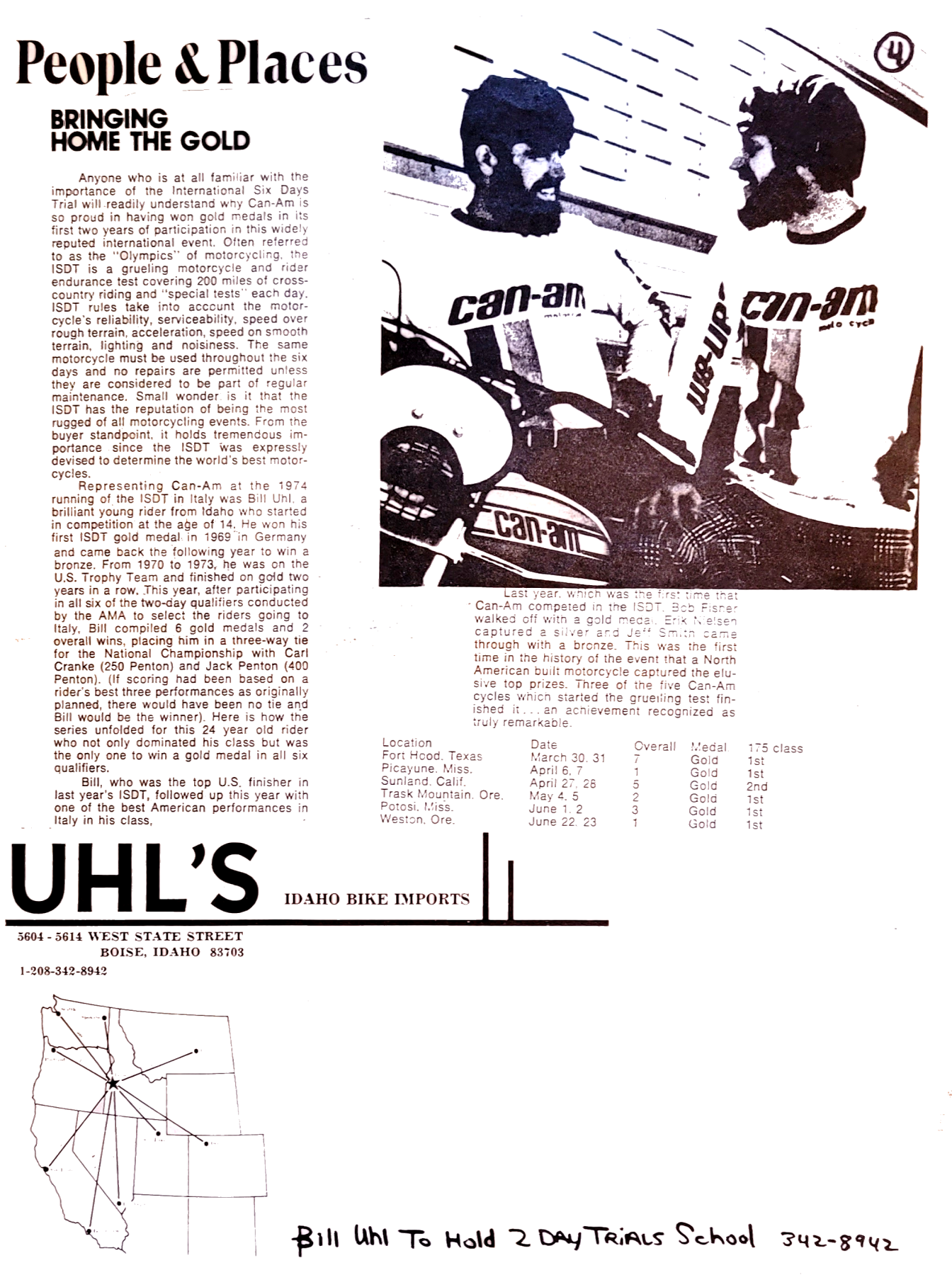
People & Places
Bringing Home the Gold
Anyone who is at all familiar with the importance of the International Six Days Trial will readily understand why Can-Am is so proud in having won gold medals in its first two years of participation in this wildly reputed international event. Often referred to as the “Olympics” of motorcycling, the ISDT is a grueling motorcycle and rider endurance test covering 200 miles of cross-country riding and “special tests” each day. ISDT rules take into account the motorcycle’s reliability, serviceability, speed over rough terrain, acceleration, speed on smooth terrain, lighting and noisiness. The same motorcycle must be used throughout the six days and no repairs are permitted unless they are considered to be part of regular maintenance. Small wonder is it that the ISDT has the reputation of being the most rugged of all motorcycling events. From the buyer standpoint, it holds tremendous importance since the ISDT was expressly devised to determine the world’s best motorcycles.
Representing Can-Am at the 1974 running on the ISDT in Italy was Bill Uhl, a brilliant young rider from Idaho who started in competition at the age of 14. He won his first ISDT gold medal in 1969 in Germany and came back the following year to win a bronze. From 1970 to 1973, he wason the U.S. Trophy Team and finished on gold two years in a row. This year, after participating in all six of the two-day qualifiers conducted by the AMA to select the riders going to Italy. Bill compiled 6 gold medals and 2 overall wins, placing him in a three-way tie for the National Championship with Carl Crank (250 Penton) and Jack Penton (400 Penton). (If scoring had been based on a rider’s best three performances, as originally planned, there would have been no tie and Bill would be the winner). Here is how the series unfolded for the 24 year old rider who not only dominated his class but was the only one to win a gold medal in all six qualifiers.
Bill, who was the top U.S. finisher in last year’s ISDT, followed up this year with one of the best American performances in Italy in his class.
Last year, which was the first time that Can-Am competed in the ISDT, Bob Fisher walked off with a gold medal, Erik Nielsen captured a silver, and Jeff Smith came through with a bronze. This was the first time in the history of the event that a North American built motorcycle captured the elusive top prizes. Three of the five Can-Am cycles which started the grueling test finished it… an achievement recognized as truly remarkable.
Location
Date
Overall
Medal
175 class
Fort Hood, Texas
March 30, 31
7
Gold
1st
Picayune, Miss.
April 6, 7
1
Gold
1st
Sunland, Calif.
April 27, 28
5
Gold
2nd
Trask Mountain, Ore.
May 4, 5
2
Gold
1st
Potosi, Miss.
June 1, 2
3
Gold
1st
Weston, Ore.
June 22, 23
1
Gold
1st
Bill Uhl to hold 2 Day Trials School: 342-8942
Uhl’s Idaho Bike Imports
5604 – 5614 West State Street, Boise, Idaho 83708
April 27, 1975
(4)
Where is Bill Uhl today? See OHV Training for more information.
In 1956, I went into the motorcycle business part-time with the pricey sum of $500.00 as my total capital investment. That was everything I had to risk. I was living in Boise, Idaho, and it was a nice little town in those days. We had roads, yes—but more importantly, we had trails heading straight into the foothills and mountains east of town.
Back then, no one hauled their dirt bike in a pickup. You just rode it from your house to wherever you wanted to go. The mountains were our playground.
Nickolas Gray from Detroit, Michigan, had just become the importer for Maico, a German brand with legendary quality. They built real enduros and scramblers with 250cc engines—exactly what we needed for Idaho riding. Before I came along, the popular bikes were Triumph, BSA, and Harley-Davidson. Big 500cc, 650cc, and 1000cc machines. Fine motorcycles, but you needed real skill to ride those big bikes in the dirt.
Most anyone, though, could have fun on a 250cc and develop skill as a side effect.
I understood that.
Very soon, I had sold so many Maicos that I had to quit my day job working on cars and become a full-time motorcycle dealer. I rented an abandoned flower shop, put up a sign, and just like that, I was in business.
By 1958, we had outgrown the flower shop, and, still working from that original $500, I put down a deposit and bought an abandoned service station farther up the street. It had a tall glass front, perfect for a showroom. Behind it was a repair area. That old service station became one of the most exciting motorcycle shops in the Northwest.
Over the years, my store was associated with 30 different motorcycle brands from 9 different countries. I did that because my loyalty was never to a manufacturer. It was always searching for what the rider wanted.
The First Honda Comes to Boise
Here’s something many people don’t realize: I was the first importer of a Honda motorcycle of any kind into the United States. After that, the Honda Company arrived in the USA.
I got the Super Cub, called the C100 or CA100 at the time, which was a scooter-like motorcycle with a pressed-steel frame, 50cc engine, three-speed transmission, and automatic clutch, and 17-inch wire wheels. It was simple, light, reliable, and brilliantly engineered.
There was just one problem. Boise didn’t want city transportation bikes.
In 1960, Boise was still a small town. People didn’t need scooters to commute through traffic. They needed something that could climb a mining road, cross a ranch, or get them into the hills for hunting season.
The Super Cub, as delivered, wasn’t that bike. Most dealers would have said, “It won’t sell here.” I didn’t see it that way.
One of my strengths is my ability to understand what the public wants in a specific product line. When I was a dealer, I understood the customers wanted a trail bike, nd nothing good was available in that category.
The Super Cub was light. It was dependable. It had a low center of gravity. It had a step-through design simplicity. What it lacked was gearing, tires, protection, and rugged purpose. So, I built what the factory had not yet imagined.
In my custom shop at Herco Engineering Co., I began modifying the Super Cub to my trail and ranch specifications. I changed gearing. I added protection, and I had knobby tires built for that size wheel. I configured it for hunting, trail riding, ranch work, and open-road travel.
What I created was not a scooter anymore. It was the first motorcycle-derived ATV. Sales escalated rapidly.
Before long, I was selling more Honda Cubs than all the dealers in the Los Angeles region combined. That caught Honda’s attention. They came to Boise to see what was going on.
I introduced them to my trail bike based on their Super Cub. They studied it carefully. They asked for specifications. They even took one of my bikes home to reverse engineer it.
In no time, Honda had production models of what became the Trail series, culminating in the legendary Trail 90.
The Trail 90 became the biggest-selling adventure bike in the world.
Did I get paid for my extra design-work?
No. I just sold way more motorcycles because I had what the customers were looking for.
I never saw a penny from that innovation itself, only for the results.
But understand this: it was never about the money. It was about making motorcycles better for the rider. It was about recognizing a need and filling it.
And frankly, Honda building my design meant I could sell more bikes with less effort, because the product now arrived already suited for my customers.
That single shift, from city transport to trail utility, helped launch an entire segment of the motorcycle industry.
From that point forward, the evolution was unstoppable:
Trail bikes
Three-wheelers
Four-wheelers
Side-by-sides
All of it traces back to one simple realization: riders wanted machines that could go where the roads ended.
People sometimes forget that the Jeep was the first automotive-derived ATV. Look at how that evolved into today’s off-road trucks and super-duty machines. The same thing happened in motorcycles. A lightweight transportation machine became a utility vehicle. A utility vehicle became a trail platform. That platform became an industry.
What began as a modified 50cc Honda in Boise, Idaho, led to multimillion-dollar windfalls for major manufacturers.
In the annals of motorcycle history, people talk about big names and big factories. But innovation does not always start in Tokyo, Munich, or Milwaukee.
Sometimes it starts in an abandoned flower shop or glass-front service station. Sometimes it starts with $500 and a willingness to see what others overlook.
I did not invent the motorcycle. I did not build the Super Cub, but I understood what the public wanted before the factories did, and when you can see potential inside an existing design, and you are willing to act on it, you can change an industry.
That is the real legacy. Not money. Not fame. Contribution.
And the satisfaction of knowing that somewhere, someone is riding a trail bike today because a dealer in Boise decided a city scooter deserved to climb a mountain.
 WHY THIS MATTERS NOW
 Visit the AMA Motorcycle Hall of Fame website →
 YOU CAN MAKE YOUR VOICE MATTER
 The Best Adventure Bike: How to Own the Best Adventure Bike Now