The Best Adventure Bike Is Right Around the Corner

Most riders are waiting. They’re waiting for the manufacturers to build the perfect adventure bike. Waiting for the next model year. Waiting for more horsepower. Waiting for longer suspension. Waiting for the marketing department to tell them they’ve finally arrived. I have news for you. The best adventure bike is not five years away. It’s right around the corner. Its platform might already be sitting in your garage.
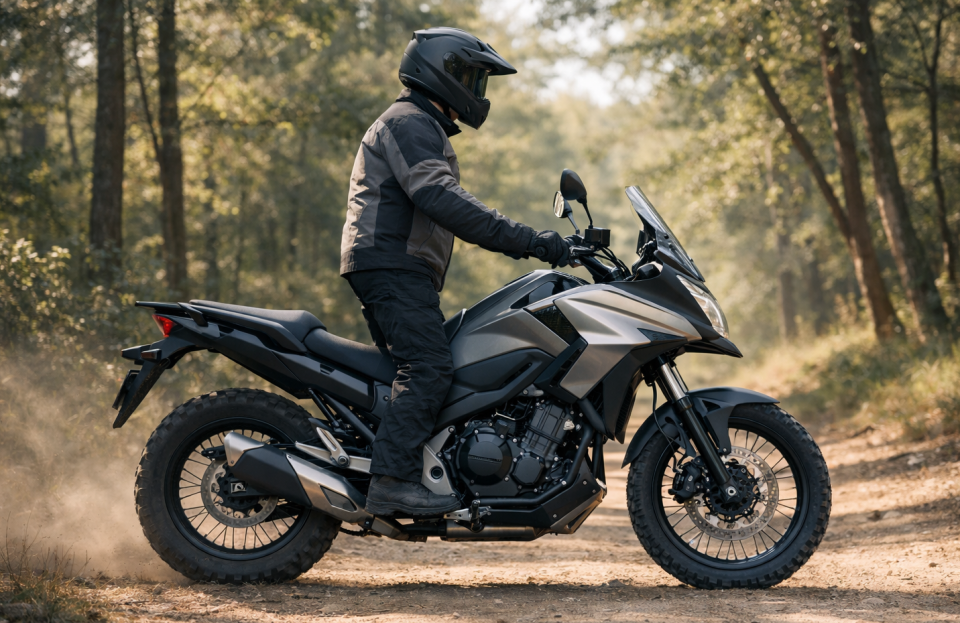
Stop Looking for Bigger. Start Looking for Better.

The modern adventure bike industry has convinced riders that bigger equals better.

    • Bigger engine.
    • Bigger fuel tank.
    • Bigger seat height.
    • Bigger electronics package.

But adventure riding is not about size. It’s about balance.

A true adventure bike must do three things exceptionally well:

    1. Be manageable at low speed
    2. Be comfortable for long distance
    3. Be forgiving off pavement

Most of the 1200cc+ machines fail the first test before you leave the driveway.

Adventure begins where confidence lives. And confidence lives in geometry, weight distribution, and predictability, not in horsepower charts.
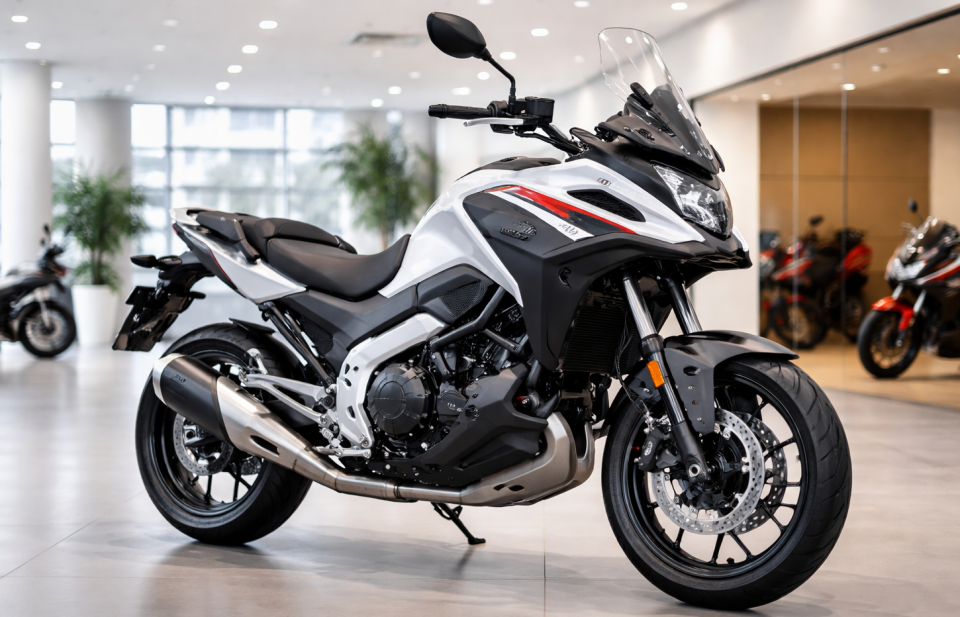
Honda NC 750X fully clothed

If You Own a Honda NC750X, You’re Already Halfway There

Let’s talk rider-to-rider; the Honda NC750X platform is one of the most misunderstood motorcycles on the market.

    • Low center of gravity.
    • Forward-leaning engine.
    • Under-seat fuel tank.
    • Neutral ergonomics.
    • Excellent fuel economy.
    • Long service intervals.

It was designed around balance.

The problem? It was never finished.

Honda built the foundation. They left the refinement to us. That’s not a criticism. It’s an opportunity.

Three Modifications That Change Everything

You don’t need to redesign the bike. You refine it.

    1. Improve the Front Suspension

The conventional telescopic fork introduces stiction and fatigue, especially under braking and on washboard surfaces.

You can:

        • Upgrade internals
        • Re-spring properly for your weight
        • Or, in my view, explore alternative front-end concepts that reduce dive and increase rider endurance

Fatigue is the enemy of adventure. When the front-end stops punishing you, the whole ride changes.

    1. Raise It — But Thoughtfully

Most adventure riders want more ground clearance. That’s fine. But raising a bike without respecting steering geometry ruins handling.

The NC’s low engine placement gives you room to:

        • Add slightly longer suspension travel
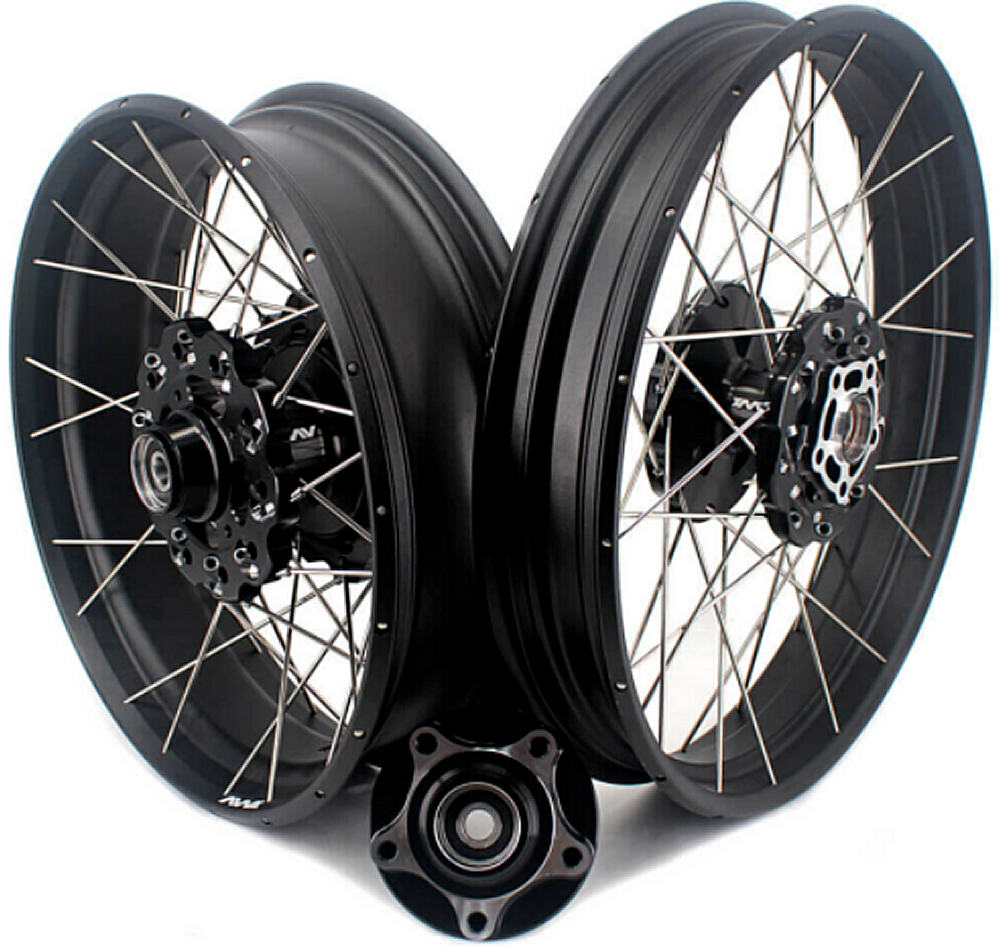
        • Fit a 19-inch front wire wheel
        • Use proper adventure tires

Done correctly, the bike becomes more stable in loose terrain without sacrificing road manners.

Done incorrectly, you’ve built a tall touring bike that falls over easily.

Geometry matters.

    1. Reduce Unnecessary Plastic

Adventure bikes carry too much decorative bodywork.

        • Strip weight where it serves no function.
        • Protect what matters.
        • Keep it serviceable.

A motorcycle designed for travel should be easy to maintain on the side of the road. If you can’t reach it, you can’t fix it.

The Secret Most Riders Miss

Adventure riding is not about conquering terrain. It’s about endurance. Your body is part of the machine.

When weight is carried low, when the front suspension doesn’t bind, when the seat allows movement, when the controls are neutral, you ride longer with less strain.

That’s the difference between surviving a ride and enjoying it.
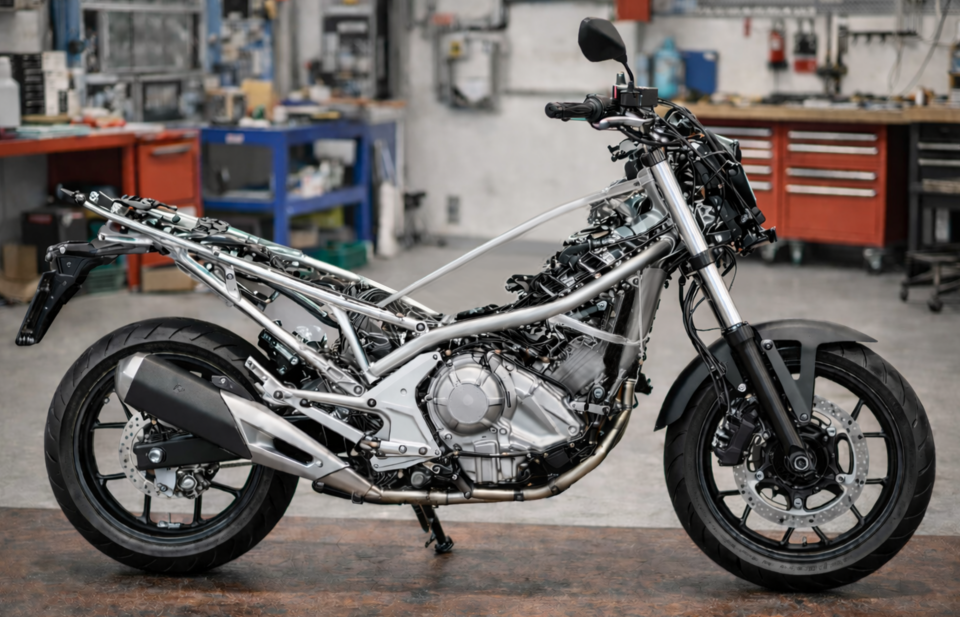
Honda NC-series: The Best Adventure Bike Bones


Why the NC Platform Works So Well

The engine in the NC series leans forward aggressively. That lowers the center of gravity dramatically.

When you add a properly tuned suspension and slightly increase travel, the result is something unusual:

    • A mid-size machine that feels lighter than it is.
    • Stable on pavement.
    • Predictable on gravel.
    • Manageable when loaded.
    • Easy to pick up.

This is not theory. It’s mechanical truth, and it’s sitting in dealerships everywhere.

The Best Adventure Bike Is Built, Not Bought

Manufacturers build for the average customer. You are not average.

The best adventure bike in the world will not roll off an assembly line fully formed. It will be tuned, carefully, by someone who understands balance more than branding.

If you already own an NC750X, you’re ahead of the curve.

If you own another mid-size adventure sport machine, you can apply the same principles:

    • Lower center of gravity
    • Reduce rider fatigue
    • Improve suspension efficiency
    • Increase functional ground clearance
    • Remove unnecessary weight

Do that, and your bike transforms from showroom model to true travel machine.

The Best Adventure Bike

Right Around the Corner

People keep asking me when the perfect adventure bike is coming. It’s not coming. It’s being built. One thoughtful modification at a time.

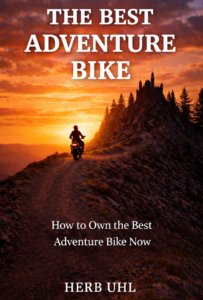
If you want the complete blueprint, geometry considerations, suspension philosophy, wheel sizing logic, rider fatigue analysis, and design corrections, it’s all laid out step by step in my book, The Best Adventure Bike, available in bookstores and on Amazon.

Because the best adventure bike is not a rumor, it’s right around the corner, and it might already have your name on the title.
 

The Best Adventure Bike: How to Own the Best Adventure Bike Now

What if the best adventure bike already exists—just not the way the factories sell it?

For more than forty years, motorcycle manufacturers have tried to define the “adventure bike” by adding more of everything: bigger engines, taller suspensions, more electronics, more accessories, and more marketing. The result has been motorcycles that look adventurous but leave many riders exhausted, intimidated, and fighting their machines long before the ride is over.

That didn’t sit right with me.

I’ve spent over eighty years riding, racing, selling, importing, and redesigning motorcycles—not from behind a desk, but from the saddle and the shop floor. Long ago, I took an ordinary Honda commuter motorcycle, stripped away its city clothing, and turned it into the original Honda Trail Bike. Honda adopted that design, and it went on to change motorcycling worldwide.

Today, I see the same opportunity again.

The Best Adventure Bike Book

In The Best Adventure Bike: How to Own the Best Adventure Bike Now, I explain why most modern adventure bikes are really just street bikes in disguise—and why true adventure riding demands a different way of thinking. This is not a book about brand loyalty, spec sheets, or the latest models. It’s about fundamentals: balance, fatigue, leverage, comfort, and real-world usability.

Adventure riders have never been asking for more horsepower or more complexity. They’ve been asking for motorcycles that are comfortable enough to ride all day, stable enough to inspire confidence, and honest enough to do what they claim—especially when the pavement ends, and the miles add up.

This book covers:

    • Why low center of gravity matters more than horsepower
    • Why engine cylinders should point forward, not high in the frame
    • Why independent front suspension dramatically reduces fatigue and improves control
    • Why seat height adjustability is essential, not optional
    • Why true utility can only be designed by riders with thousands of hours in the saddle

Rather than attacking manufacturers, I point out something more interesting: in at least one case, the factory is already almost there. Just like in the 1960s, the bones of a great adventure bike already exist—waiting for riders to see past the factory façade and finish the job.

Most importantly, this book doesn’t ask you to wait.

It shows how riders can apply these principles right now—by understanding platforms, recognizing good engineering when they see it, and choosing or modifying motorcycles intelligently rather than emotionally. The goal is simple: ride longer, ride farther, and arrive with energy left.

If you’ve ever thought an adventure bike felt promising at first but became exhausting over distance, this book is for you. And if you’ve ever said, there has to be a better way to design this, you’re probably right.

This book explains why—and shows you how to own the best adventure bike now.

Herb Uhl

👉 Available now on Amazon


ADVENTURE Motorcycles for Smaller Adults

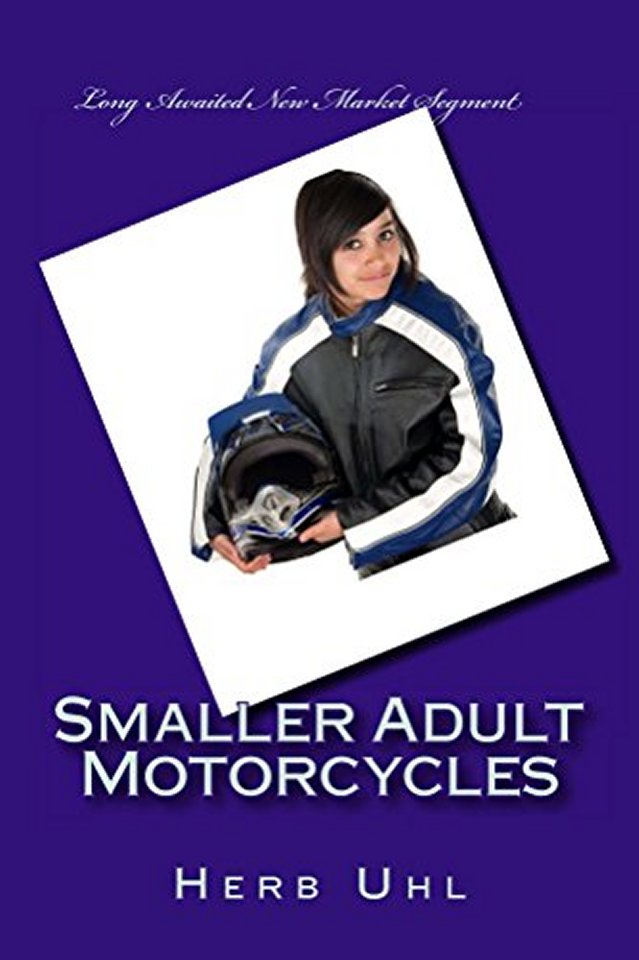
In 2016 I wrote the book, Smaller Adult Motorcycles, where I outlined what was necessary to get almost twice as many people riding and enjoying motorcycles.

The book explained that around half of the world’s population didn’t even try to ride because the most desirable motorcycles (the adventure bikes) had seats way too high for about one-half of the population to touch the ground while sitting at a stop light.

It is definitely a safety issue for a rider to slide almost off the seat to be able to touch one toe on the ground to balance the bike.

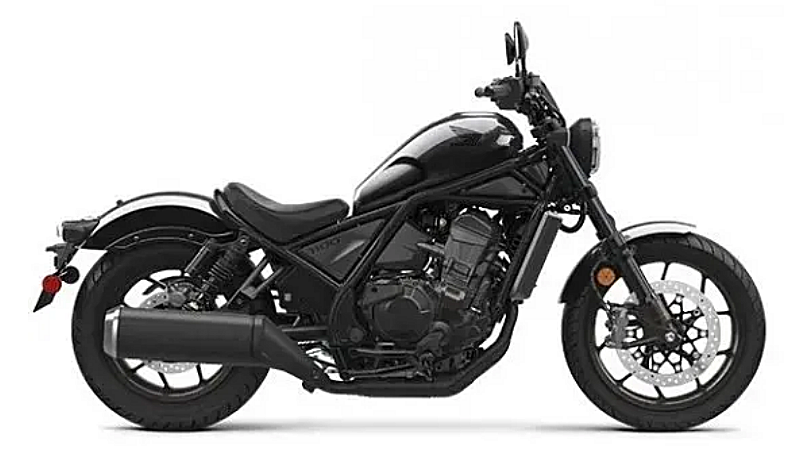
The response of the motorcycle manufacturers was interesting, so I’ll outline our progress for you. Many of them have since emphasized the low seat height on their cruisers but they mostly still have only 2 or 3 inches of suspension travel, except for Honda’s Rebel line which almost has useable suspension travel.

Harley Davidson has designed an adventure bike that squats somewhat at stop lights but you have to pay extra for that feature.

BMW and a couple of others have made a seat that has a couple of mounting positions with an inch or so difference in height.

As yet, none of the manufacturers have designed a frame architecture that could be made into a proper adventure bike for short inseam people, except Honda. Just like when I saw a proper trail bike lurking inside Honda’s Super Cub, I can see a proper adventure bike for short people lurking inside the basic frame design of Honda’s popular Rebel line.

Like before, Honda doesn’t realize that they have almost built the adventure bike for us short inseam people that we have been waiting for all these years since adventure motorcycles started. Will they do anything about it? We’ll just have to wait and see.

Honda has already developed the necessary technology, so it’d probably be a very quick redesign. First, and most importantly, they would need to make a smaller version of their Gold Wing fork to give the Rebel Adventure bike independent front suspension. That way, it would have more compliance and a better ride with just 7-inches of travel than if they had 12 to 14-inches of travel with telescopic forks.

Second, the shocks on both ends should be electronically controlled.

Third, it should have a 17-inch tubeless wire wheel on the rear and a 21-inch wire wheel on the front.

Fourth, it should have an easily adjustable seat from a 27-inch seat height to a 32-inch seat height, so that almost any member of the family can ride it just like they can drive the family car.

The Best Adventure Bike

They already have Rebels available clear from 300cc up to 1100cc, and that should satisfy even the most power-hungry rider in the family.

If Honda made this move, I’d be surprised if they could manufacture enough of them to meet the demand

~Herb Uhl


From $500 and a Flower Shop to the First Trail Bike Revolution

In 1956, I went into the motorcycle business part-time with the pricey sum of $500.00 as my total capital investment. That was everything I had to risk. I was living in Boise, Idaho, and it was a nice little town in those days. We had roads, yes—but more importantly, we had trails heading straight into the foothills and mountains east of town.

Back then, no one hauled their dirt bike in a pickup. You just rode it from your house to wherever you wanted to go. The mountains were our playground.

Nickolas Gray from Detroit, Michigan, had just become the importer for Maico, a German brand with legendary quality. They built real enduros and scramblers with 250cc engines—exactly what we needed for Idaho riding. Before I came along, the popular bikes were Triumph, BSA, and Harley-Davidson. Big 500cc, 650cc, and 1000cc machines. Fine motorcycles, but you needed real skill to ride those big bikes in the dirt.

Most anyone, though, could have fun on a 250cc and develop skill as a side effect.

I understood that.

Very soon, I had sold so many Maicos that I had to quit my day job working on cars and become a full-time motorcycle dealer. I rented an abandoned flower shop, put up a sign, and just like that, I was in business.

By 1958, we had outgrown the flower shop, and, still working from that original $500, I put down a deposit and bought an abandoned service station farther up the street. It had a tall glass front, perfect for a showroom. Behind it was a repair area. That old service station became one of the most exciting motorcycle shops in the Northwest.

Over the years, my store was associated with 30 different motorcycle brands from 9 different countries. I did that because my loyalty was never to a manufacturer. It was always searching for what the rider wanted.

The First Honda Comes to Boise

Here’s something many people don’t realize: I was the first importer of a Honda motorcycle of any kind into the United States. After that, the Honda Company arrived in the USA.

I got the Super Cub, called the C100 or CA100 at the time, which was a scooter-like motorcycle with a pressed-steel frame, 50cc engine, three-speed transmission, and automatic clutch, and 17-inch wire wheels. It was simple, light, reliable, and brilliantly engineered.

There was just one problem. Boise didn’t want city transportation bikes.

In 1960, Boise was still a small town. People didn’t need scooters to commute through traffic. They needed something that could climb a mining road, cross a ranch, or get them into the hills for hunting season.

The Super Cub, as delivered, wasn’t that bike. Most dealers would have said, “It won’t sell here.” I didn’t see it that way.

One of my strengths is my ability to understand what the public wants in a specific product line. When I was a dealer, I understood the customers wanted a trail bike, nd nothing good was available in that category.

The Super Cub was light. It was dependable. It had a low center of gravity. It had a step-through design simplicity. What it lacked was gearing, tires, protection, and rugged purpose. So, I built what the factory had not yet imagined.

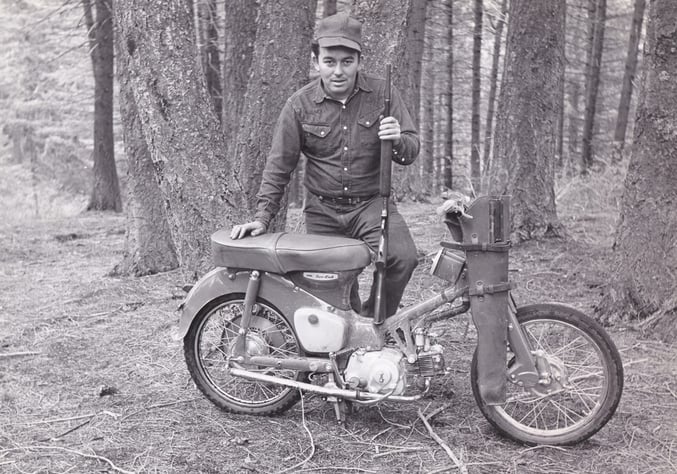
In my custom shop at Herco Engineering Co., I began modifying the Super Cub to my trail and ranch specifications. I changed gearing. I added protection, and I had knobby tires built for that size wheel. I configured it for hunting, trail riding, ranch work, and open-road travel.

What I created was not a scooter anymore. It was the first motorcycle-derived ATV. Sales escalated rapidly.

Before long, I was selling more Honda Cubs than all the dealers in the Los Angeles region combined. That caught Honda’s attention. They came to Boise to see what was going on.

I introduced them to my trail bike based on their Super Cub. They studied it carefully. They asked for specifications. They even took one of my bikes home to reverse engineer it.

In no time, Honda had production models of what became the Trail series, culminating in the legendary Trail 90.

The Trail 90 became the biggest-selling adventure bike in the world.

Did I get paid for my extra design-work?

No. I just sold way more motorcycles because I had what the customers were looking for.

I never saw a penny from that innovation itself, only for the results.

But understand this: it was never about the money. It was about making motorcycles better for the rider. It was about recognizing a need and filling it.

And frankly, Honda building my design meant I could sell more bikes with less effort, because the product now arrived already suited for my customers.

That single shift, from city transport to trail utility, helped launch an entire segment of the motorcycle industry.

From that point forward, the evolution was unstoppable:

    • Trail bikes
    • Three-wheelers
    • Four-wheelers
    • Side-by-sides

All of it traces back to one simple realization: riders wanted machines that could go where the roads ended.

People sometimes forget that the Jeep was the first automotive-derived ATV. Look at how that evolved into today’s off-road trucks and super-duty machines. The same thing happened in motorcycles. A lightweight transportation machine became a utility vehicle. A utility vehicle became a trail platform. That platform became an industry.

What began as a modified 50cc Honda in Boise, Idaho, led to multimillion-dollar windfalls for major manufacturers.

The Best Adventure Bike

In the annals of motorcycle history, people talk about big names and big factories. But innovation does not always start in Tokyo, Munich, or Milwaukee.

Sometimes it starts in an abandoned flower shop or glass-front service station. Sometimes it starts with $500 and a willingness to see what others overlook.

I did not invent the motorcycle. I did not build the Super Cub, but I understood what the public wanted before the factories did, and when you can see potential inside an existing design, and you are willing to act on it, you can change an industry.

That is the real legacy. Not money. Not fame. Contribution.

And the satisfaction of knowing that somewhere, someone is riding a trail bike today because a dealer in Boise decided a city scooter deserved to climb a mountain.