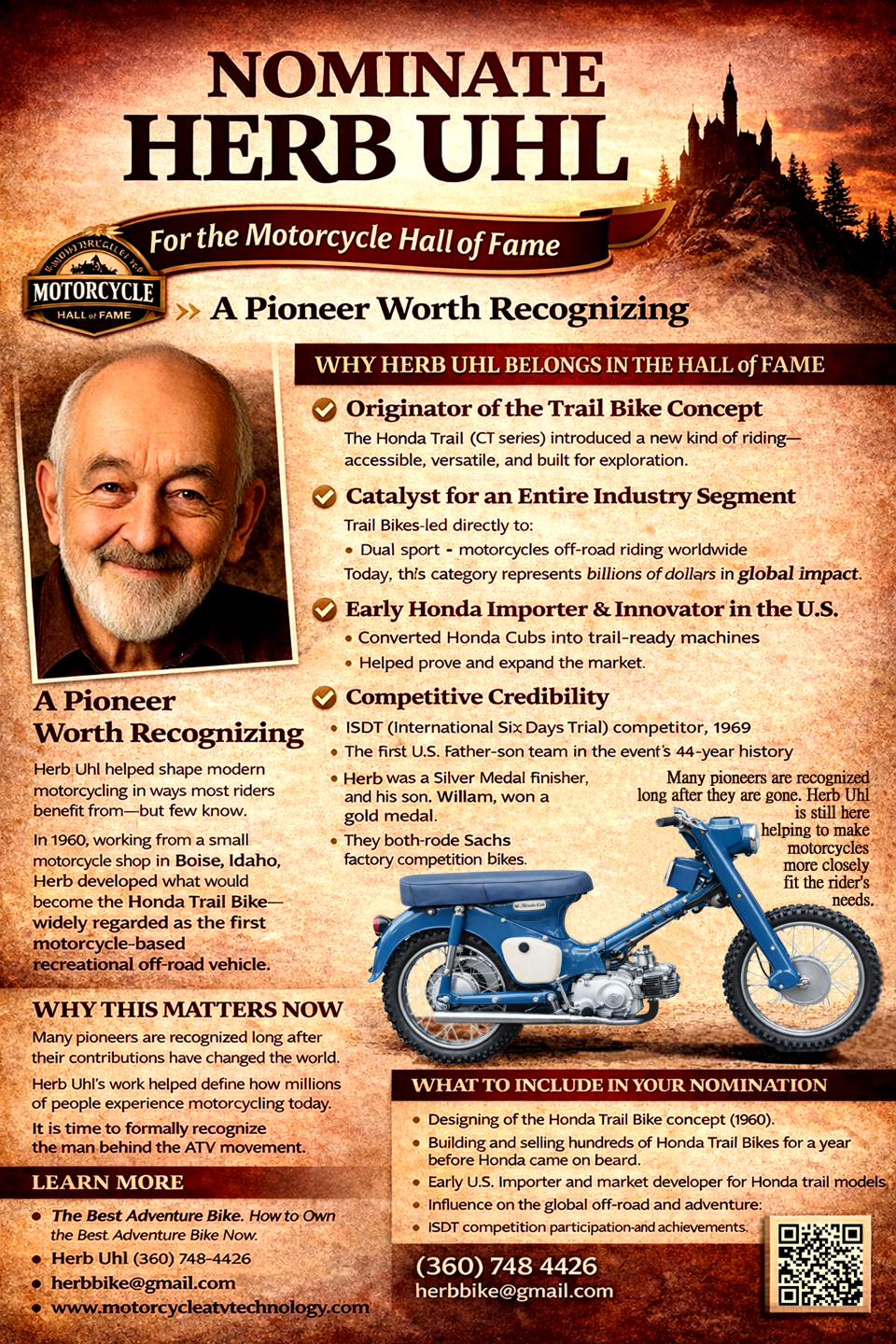
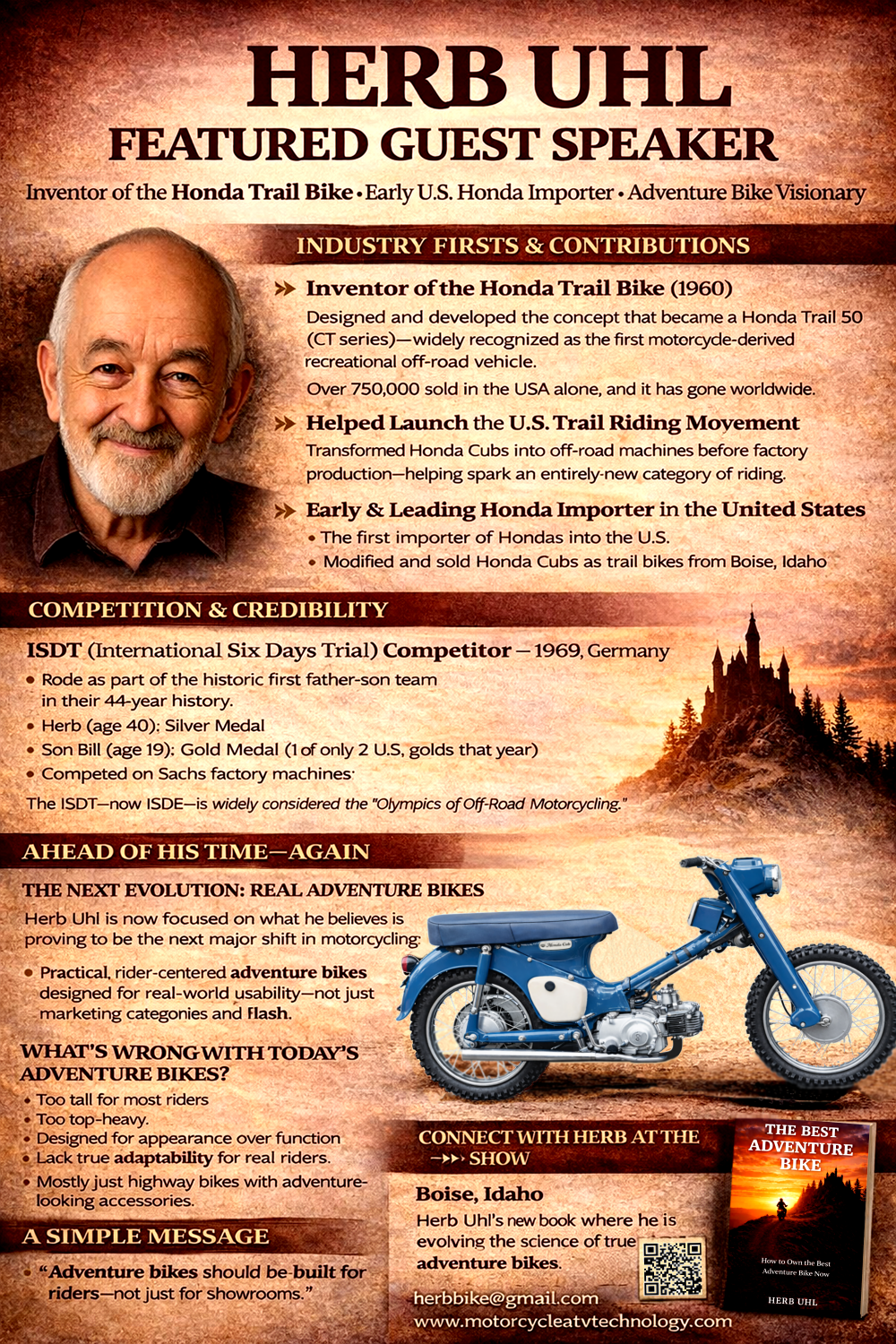
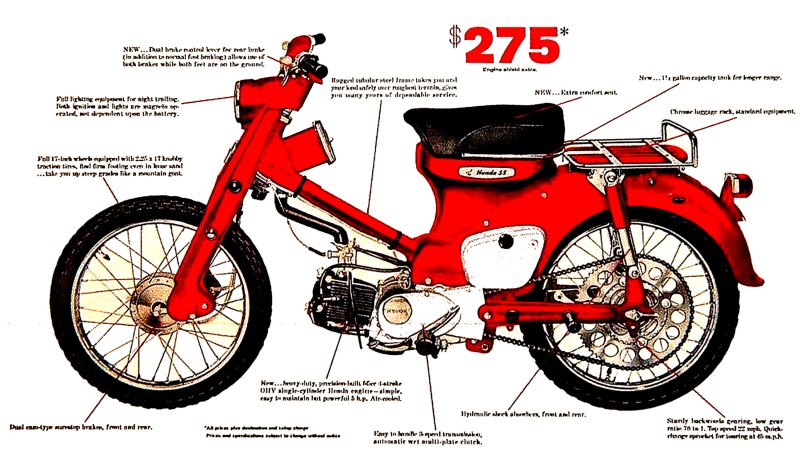
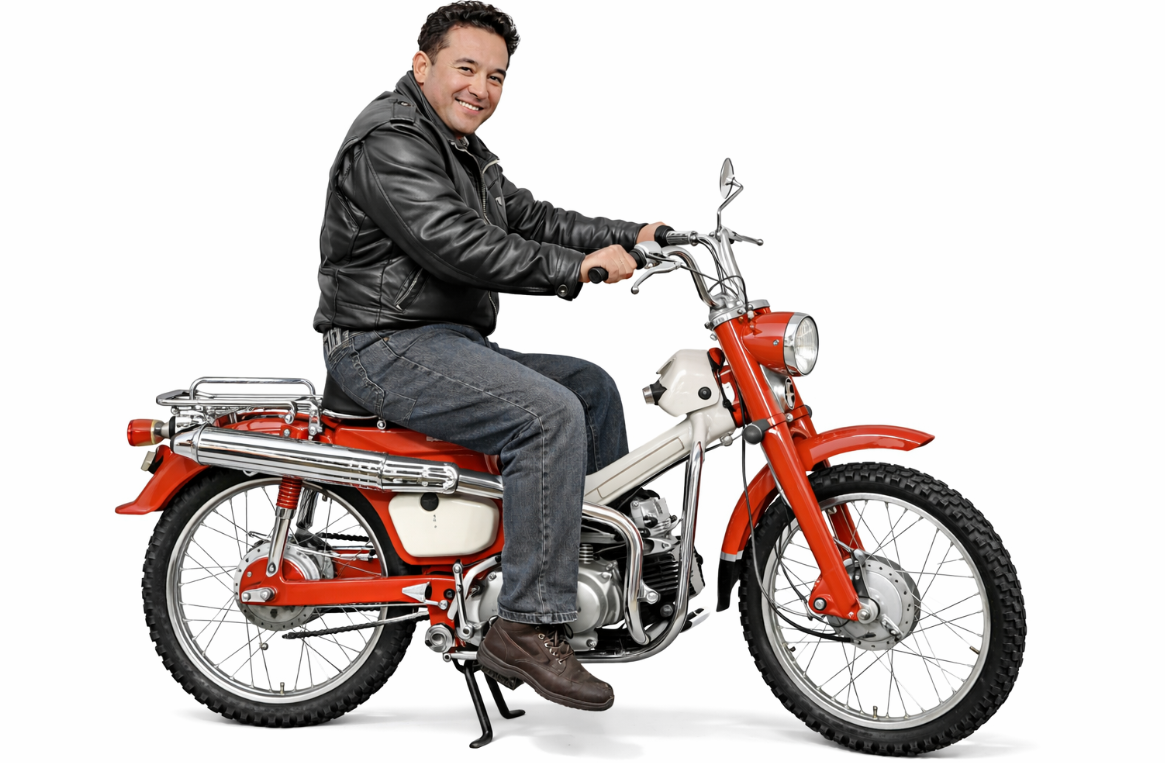
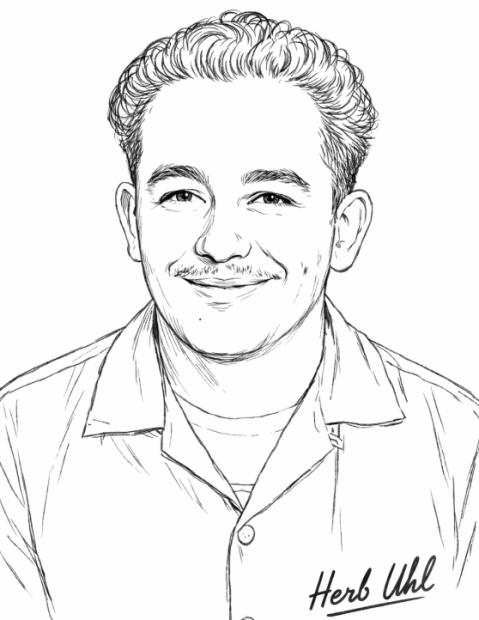
Herb Uhl helped shape modern motorcycling in ways most riders benefit from—but few know. In 1960, working from a small motorcycle shop in Boise, Idaho, Herb developed what would become the Honda Trail Bike—widely regarded as the first motorcycle-based recreational off-road vehicle. That idea didn’t just create a product. It created a movement.
How would you like to help Herb Uhl get into the AMA Motorcycle Hall of Fame? The AMA Motorcycle Hall of Fame accepts nominations from the public.
WHY HERB UHL BELONGS IN THE HALL OF FAME
✔ Originator of the Trail Bike Concept
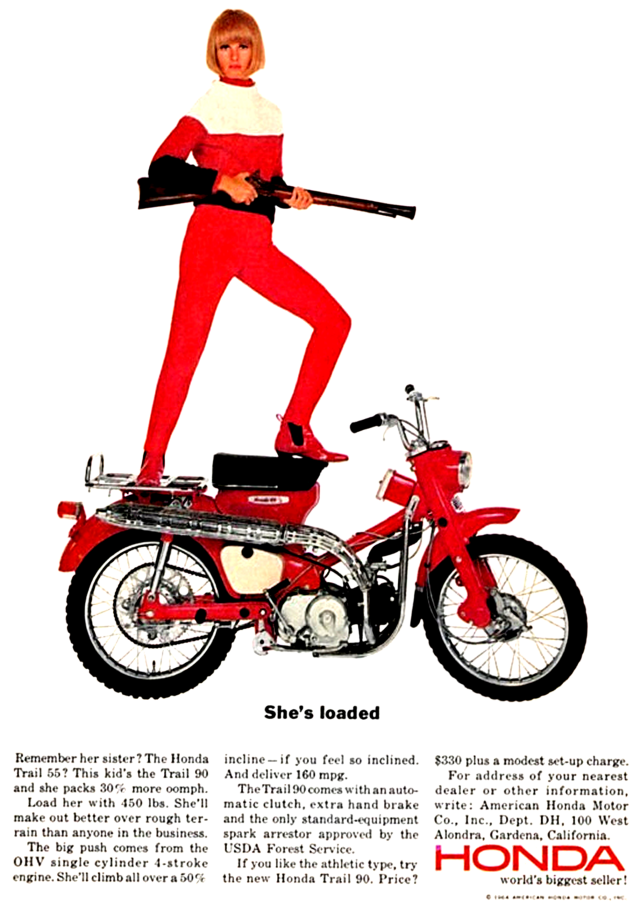
The Honda Trail 50 (CT series) introduced a new kind of riding—accessible, versatile, and built for exploration.
✔ Catalyst for an Entire Industry Segment
Trail bikes led directly to:
Recreational + business off-road riding worldwide
Today, this category represents billions of dollars in global impact.
✔ Early Honda Importer & Innovator in the U.S.
Before factory production:
Converted Honda Cubs into trail-ready machines
Helped prove and expand the market
✔ Competitive Credibility
ISDT (International Six Days Trial) competitor, 1969 at age 40
The first U.S. father-son team in the event’s 44-year history
Herb was a Silver Medal finisher, and his son, William, won a gold medal
They both rode Sachs factory competition bikes
✔ A Lifetime of Contribution
At 97 years old, Herb continues contributing ideas to improve motorcycle design—most recently through his work on practical, rider-centered adventure bikes.
WHY THIS MATTERS NOW
Many pioneers are recognized long after their contributions have changed the world. Herb Uhl’s work helped define how millions of people experience motorcycling today. It is time to formally recognize the man behind the ATV movement.
Most riders are waiting. They’re waiting for the manufacturers to build the perfect adventure bike. Waiting for the next model year. Waiting for more horsepower. Waiting for longer suspension. Waiting for the marketing department to tell them they’ve finally arrived. I have news for you. The best adventure bike is not five years away. It’s right around the corner. Its platform might already be sitting in your garage.
Stop Looking for Bigger. Start Looking for Better.
The modern adventure bike industry has convinced riders that bigger equals better.
Bigger engine.
Bigger fuel tank.
Bigger seat height.
Bigger electronics package.
But adventure riding is not about size. It’s about balance.
A true adventure bike must do three things exceptionally well:
Be manageable at low speed
Be comfortable for long distance
Be forgiving off pavement
Most of the 1200cc+ machines fail the first test before you leave the driveway.
Adventure begins where confidence lives. And confidence lives in geometry, weight distribution, and predictability, not in horsepower charts.
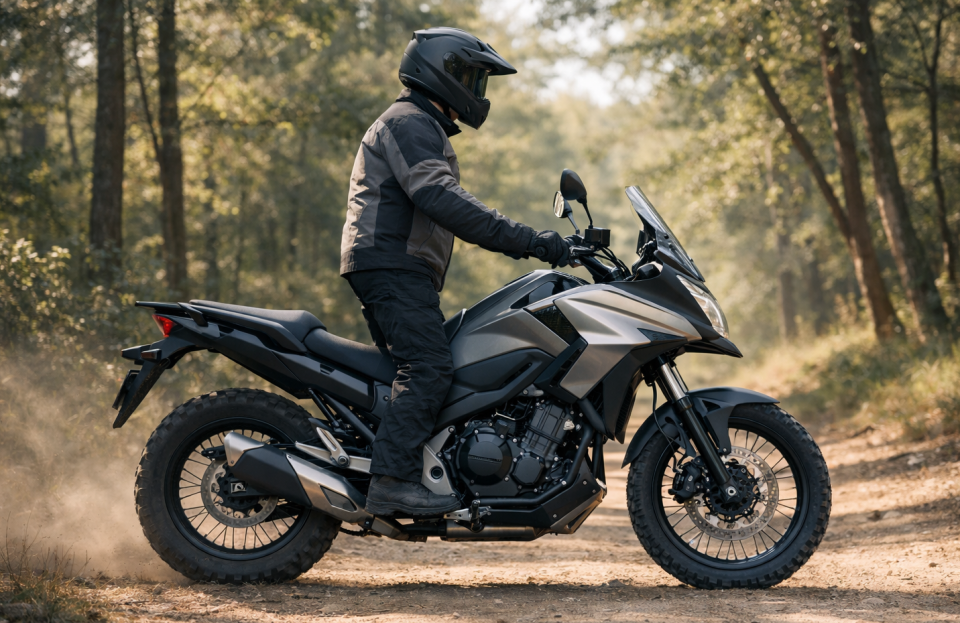
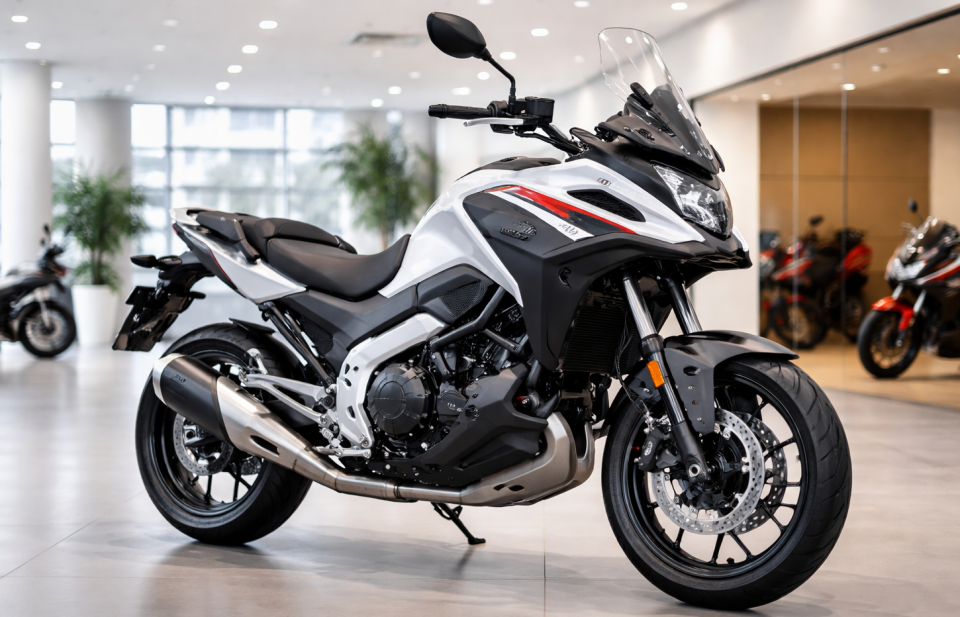
Honda NC 750X fully clothed
If You Own a Honda NC750X, You’re Already Halfway There
Let’s talk rider-to-rider; the Honda NC750X platform is one of the most misunderstood motorcycles on the market.
Low center of gravity.
Forward-leaning engine.
Under-seat fuel tank.
Neutral ergonomics.
Excellent fuel economy.
Long service intervals.
It was designed around balance.
The problem? It was never finished.
Honda built the foundation. They left the refinement to us. That’s not a criticism. It’s an opportunity.
Three Modifications That Change Everything
You don’t need to redesign the bike. You refine it.
Improve the Front Suspension
The conventional telescopic fork introduces stiction and fatigue, especially under braking and on washboard surfaces.
You can:
Upgrade internals
Re-spring properly for your weight
Or, in my view, explore alternative front-end concepts that reduce dive and increase rider endurance
Fatigue is the enemy of adventure. When the front-end stops punishing you, the whole ride changes.
Raise It — But Thoughtfully
Most adventure riders want more ground clearance. That’s fine. But raising a bike without respecting steering geometry ruins handling.
The NC’s low engine placement gives you room to:
Add slightly longer suspension travel
Fit a 19-inch front wire wheel
Use proper adventure tires
Done correctly, the bike becomes more stable in loose terrain without sacrificing road manners.
Done incorrectly, you’ve built a tall touring bike that falls over easily.
Geometry matters.
Reduce Unnecessary Plastic
Adventure bikes carry too much decorative bodywork.
Strip weight where it serves no function.
Protect what matters.
Keep it serviceable.
A motorcycle designed for travel should be easy to maintain on the side of the road. If you can’t reach it, you can’t fix it.
The Secret Most Riders Miss
Adventure riding is not about conquering terrain. It’s about endurance. Your body is part of the machine.
When weight is carried low, when the front suspension doesn’t bind, when the seat allows movement, when the controls are neutral, you ride longer with less strain.
That’s the difference between surviving a ride and enjoying it.
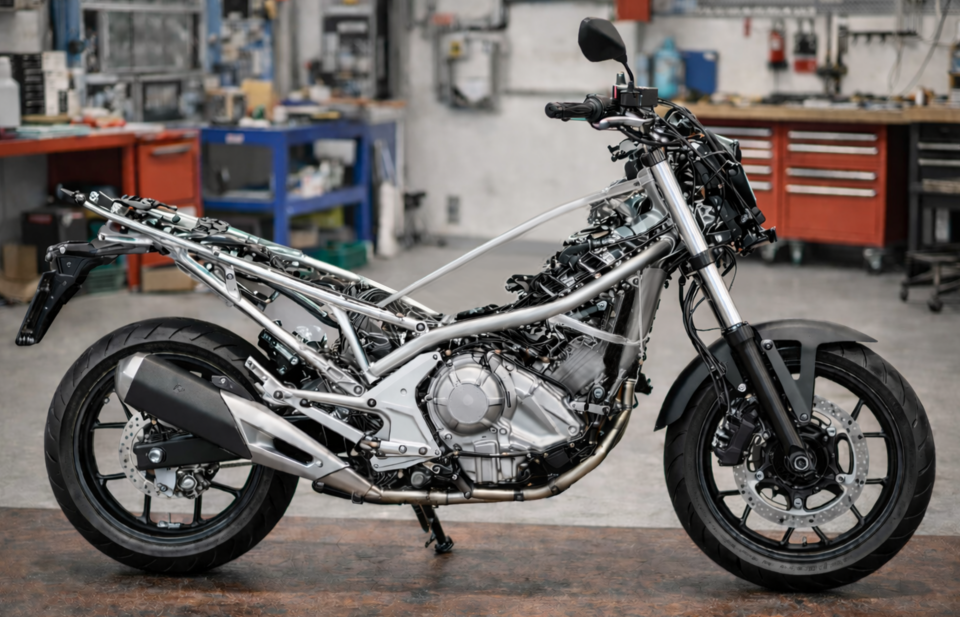
Honda NC-series: The Best Adventure Bike Bones
Why the NC Platform Works So Well
The engine in the NC series leans forward aggressively. That lowers the center of gravity dramatically.
When you add a properly tuned suspension and slightly increase travel, the result is something unusual:
A mid-size machine that feels lighter than it is.
Stable on pavement.
Predictable on gravel.
Manageable when loaded.
Easy to pick up.
This is not theory. It’s mechanical truth, and it’s sitting in dealerships everywhere.
The Best Adventure Bike Is Built, Not Bought
Manufacturers build for the average customer. You are not average.
The best adventure bike in the world will not roll off an assembly line fully formed. It will be tuned, carefully, by someone who understands balance more than branding.
If you already own an NC750X, you’re ahead of the curve.
If you own another mid-size adventure sport machine, you can apply the same principles:
Lower center of gravity
Reduce rider fatigue
Improve suspension efficiency
Increase functional ground clearance
Remove unnecessary weight
Do that, and your bike transforms from showroom model to true travel machine.
People keep asking me when the perfect adventure bike is coming. It’s not coming. It’s being built. One thoughtful modification at a time.
If you want the complete blueprint, geometry considerations, suspension philosophy, wheel sizing logic, rider fatigue analysis, and design corrections, it’s all laid out step by step in my book, The Best Adventure Bike, available in bookstores and on Amazon.
Because the best adventure bike is not a rumor, it’s right around the corner, and it might already have your name on the title.
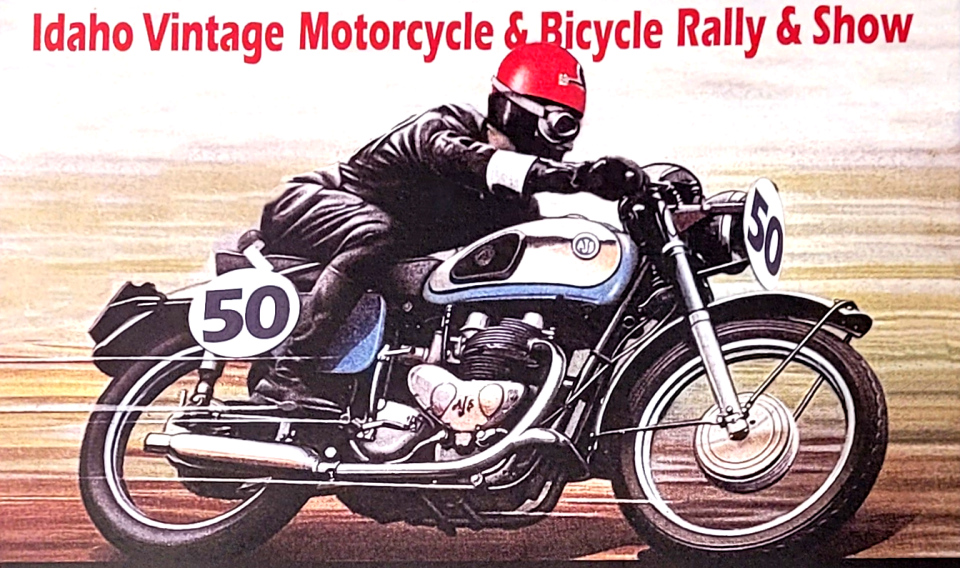
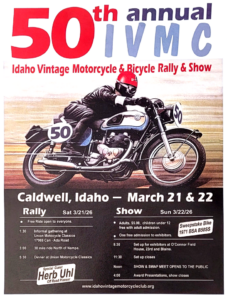
I’m honored to share that I’ve been invited to serve as keynote speaker at the 50th Annual Idaho Vintage Motorcycle & Bicycle Rally & Show, hosted by the Idaho Vintage Motorcycle Club in Caldwell, Idaho.
At 97 years old, I’ll be speaking about the subject of my newest book, The Best Adventure Bike: How to Own the Best Adventure Bike Now, and why the adventure category is ready—once again—for a reset led by riders, not marketing departments.
This event holds special meaning for me. Idaho has been home for much of my life, and the vintage motorcycle community understands something that modern industry often forgets: the best motorcycles were built when design served riders first.
The story I’ll be sharing isn’t about nostalgia. It’s about design fundamentals, real-world riding, and how the same thinking that led to the original Honda Trail Bike applies directly to today’s adventure motorcycles. The bones are already there. The question is whether we’re willing to see them—and act.
What if the best adventure bike already exists—just not the way the factories sell it?
For more than forty years, motorcycle manufacturers have tried to define the “adventure bike” by adding more of everything: bigger engines, taller suspensions, more electronics, more accessories, and more marketing. The result has been motorcycles that look adventurous but leave many riders exhausted, intimidated, and fighting their machines long before the ride is over.
That didn’t sit right with me.
I’ve spent over eighty years riding, racing, selling, importing, and redesigning motorcycles—not from behind a desk, but from the saddle and the shop floor. Long ago, I took an ordinary Honda commuter motorcycle, stripped away its city clothing, and turned it into the original Honda Trail Bike. Honda adopted that design, and it went on to change motorcycling worldwide.
In The Best Adventure Bike: How to Own the Best Adventure Bike Now, I explain why most modern adventure bikes are really just street bikes in disguise—and why true adventure riding demands a different way of thinking. This is not a book about brand loyalty, spec sheets, or the latest models. It’s about fundamentals: balance, fatigue, leverage, comfort, and real-world usability.
Adventure riders have never been asking for more horsepower or more complexity. They’ve been asking for motorcycles that are comfortable enough to ride all day, stable enough to inspire confidence, and honest enough to do what they claim—especially when the pavement ends, and the miles add up.
This book covers:
Why low center of gravity matters more than horsepower
Why engine cylinders should point forward, not high in the frame
Why independent front suspension dramatically reduces fatigue and improves control
Why seat height adjustability is essential, not optional
Why true utility can only be designed by riders with thousands of hours in the saddle
Rather than attacking manufacturers, I point out something more interesting: in at least one case, the factory is already almost there. Just like in the 1960s, the bones of a great adventure bike already exist—waiting for riders to see past the factory façade and finish the job.
Most importantly, this book doesn’t ask you to wait.
It shows how riders can apply these principles right now—by understanding platforms, recognizing good engineering when they see it, and choosing or modifying motorcycles intelligently rather than emotionally. The goal is simple: ride longer, ride farther, and arrive with energy left.
If you’ve ever thought an adventure bike felt promising at first but became exhausting over distance, this book is for you. And if you’ve ever said, there has to be a better way to design this, you’re probably right.
This book explains why—and shows you how to own the best adventure bike now.
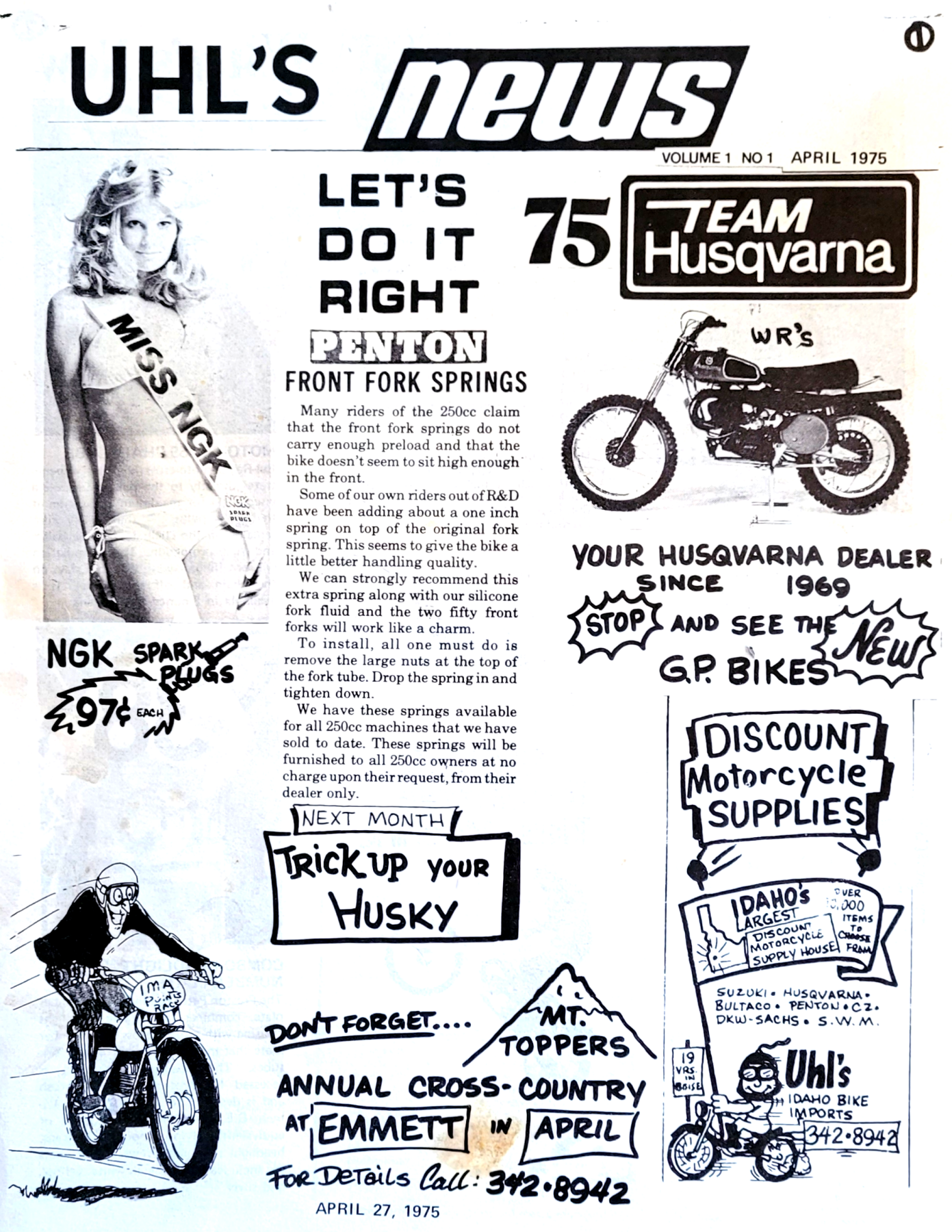
Many riders of the 250cc claim that the front fork springs to not carry enough preload and that the bike doesn’t seem to sit high enough in the front. Some of our own riders out of R&D have been adding about a one inch spring on top of the original fork spring. This seems to give the bike a little better handling quality.
We can strongly recommend this extra spring along with our silicone fork fluid and the two fifty front forks will work like a charm.
To install, all one must do is remove the large nuts at the top of the fork tube. Drop the spring in and tighten down.
We have these springs available for all 250cc machines that we have sold to date. These springs will be furnished to all 250cc owners at no charge upon their request, from their dealer only.
Next Month Trick Up Your Husky
Don’t forget: Mt. Toppers Annual Cross-Country at Emmett in April. For details call: 342-8942.
75 Team Husqvarna Your Husqvarna Dealer Since 1969. Stop and see the new G.P. Bikes
Discount Motorcycle Supplies
Idaho’s largest discount motorcycle supply house. Over 10,000 items to choose from. Suzuki – Husqvarna – Bultaco – Penton – CZ – DKW – Sachs – S.W.M. 19 years in Boise. Uhl’s Idaho Bike Imports
NGK Spark Plugs 97 cents each.
(1)
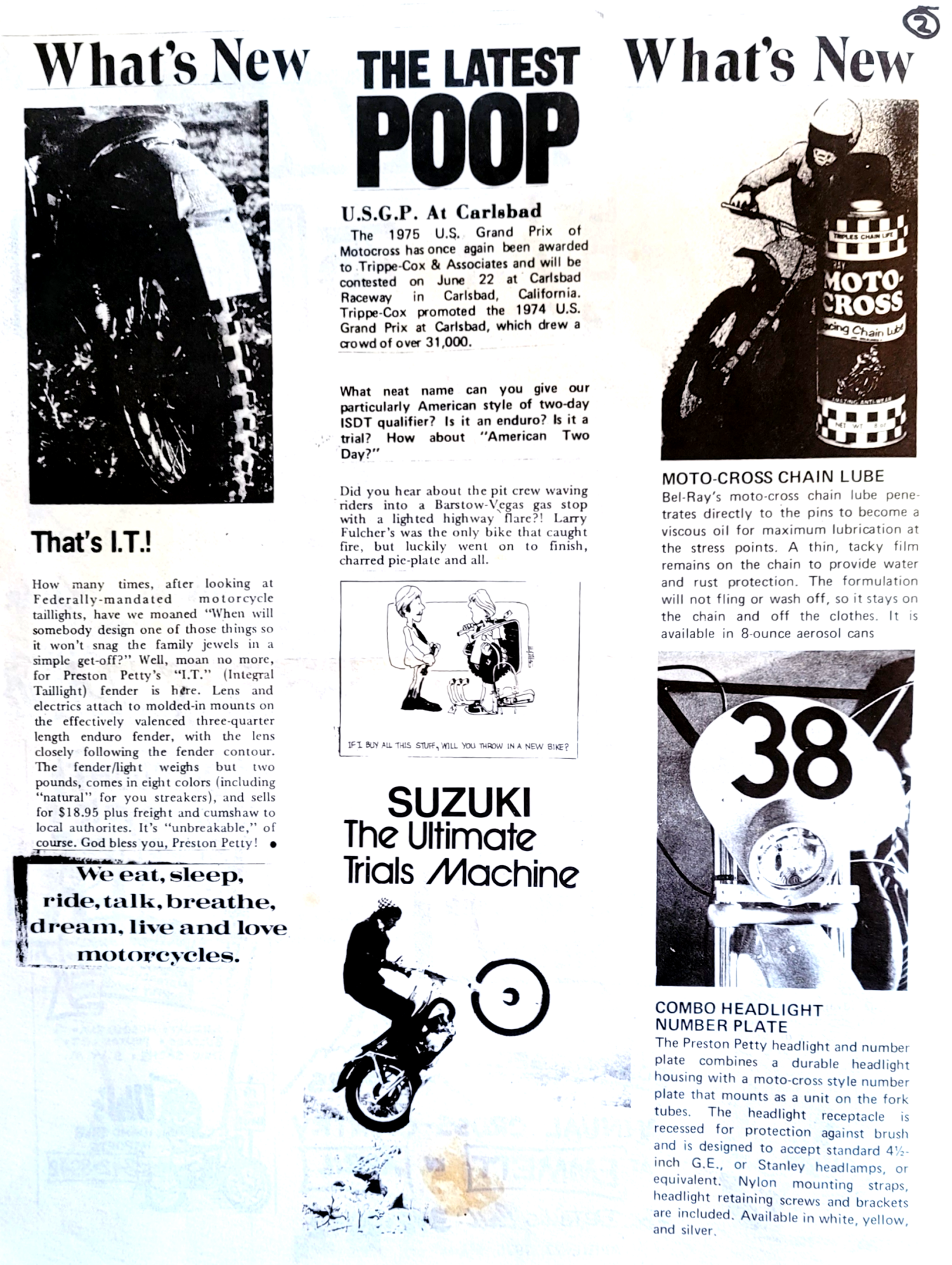
What’s New
That’s I.T.!
How many times after looking at Federally-mandated motorcycle taillights, have we moaned, “When will somebody design one of those things so it won’t snag the family jewels in a simple get off?” Well, moan no more, for Preston Petty’s “I.T.” (Integral Taillight) fender is here. Lens and electrics attach to molded-in mounts on the effectively valenced trhree quaerter length enduro fender, with the lens closely following the fender contour. The fender/light weight but two pounds, comes in eight colors (including “natural” for you streakers), and sells for $18.95 plus freight and cumshaw to local authorities. It’s “unbreakable” of course. God bless you, Preston Petty!
We eat, sleep, ride, talk, breathe, dream, live and love motorcycles.
The Latest Poop
U.S.G.P. At Carlsbad
The 1975 U.S. Graqnd Prix of Motocross has once again been awarded to Trippe-Cox & Associates and will be contested on June 22 at Carlsbad Raceway in Carlsbad, California. Trippe-Cox promoted the 1974 U.S. Grand Prix at Carlsbad, which drew a crowd of over 31,000.
What neat name can you give our particularly American style of two-day ISDT qualifier? Is it an enduro? Is it a trail? How about “American Two Day?”
Did you hear about the pit crew waving riders into a Barstoe-Vegas gas stop with a lighted highway flare?! Larry Fulcher’s was the only bike that caught fire, but luckily went on to finish, charred pie-plate and all.
Suzuki, the ultimate trails machine.
What’s New
Moto-Cross Chain Lube
Bel-Ray’s moto-cross chain lube penetrates directly to the pins to become a viscous oil for maximum lubrication at the stress points. A thin, tacky film remains on the chain to provide water and rust protection. The formulation will not fling or wash off, so it stays on the chain and off the clothes. It is available in 8-ounces aerosol cans.
Combo Headlight Number Plate
The Preston Petty headlight plate combines a durable headlight housing with a moto-cross style number plate that mounts as a unit on the fork tubes. The headlight receptacle is recessed for protection against brush ande is designed to accept standard 4 ½-inch G.E. or Stanley headlamps, or equivalent. Nylon mounting straps, headlight retaining screws and brackets are included. Available in white, yellow, and silver.
(2)
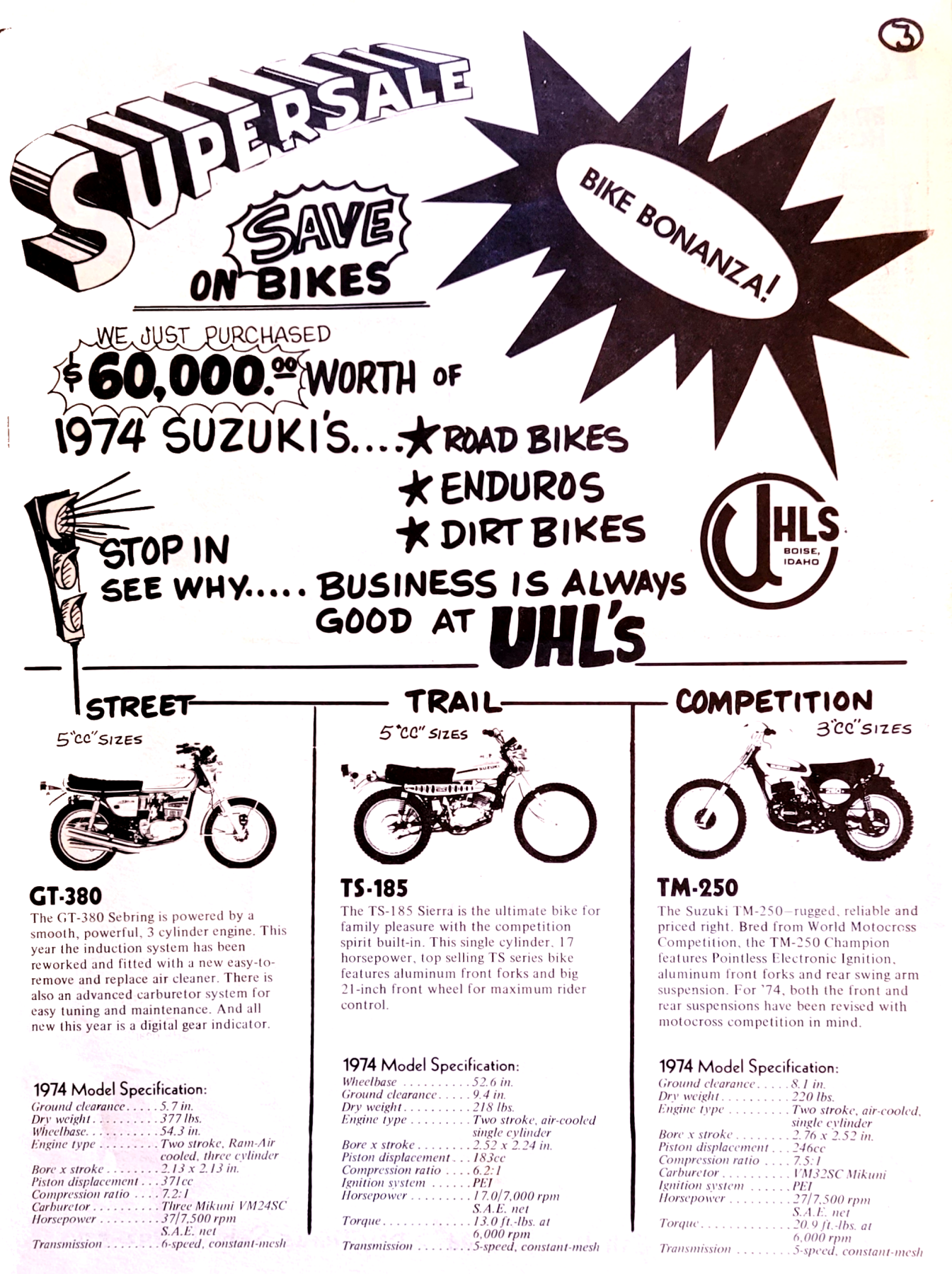
Supersale Bike Bonanza!
Save On Bikes
We just purchased $60,000.00 worth of 1974 Suzukis: Road Bikes – Enduros – Dirt Bikes
Stop in, see why… business is always good at Uhl’s, Boise, Idaho.
Street 5 ”cc” sizes
GT-380 The GT-380 Sebring is powered by a smooth, powerful, 3 cylinder engine. This year the induction system has been reworked and fitted with a new east-to-remove and replace air cleaner. There is also an advanced carburetor system for easy tuning and maintenance. And all new this year is a digital gear indicator.
Trail 5”cc” sizes
TS-185 The TS-185 Sierra is the ultimate bike for family pleasure with the competition spirit built-in. This single cylinder, 17 horsepower, top selling TS series bike features aluminum front forks and big 21-inch front wheel for maximum rider control.
Competition 3”cc” sizes
TM-250 The Suzuki TM-250-rugged, reliable and priced rightBred from World Motocross Competition, the TM-250 Champion features
Pointless Electronic Ignition, aluminum front forks and rear swing arm suspension. For ’74, both the front and rear suspensions have been revised with motocross competition in mind.
(3)
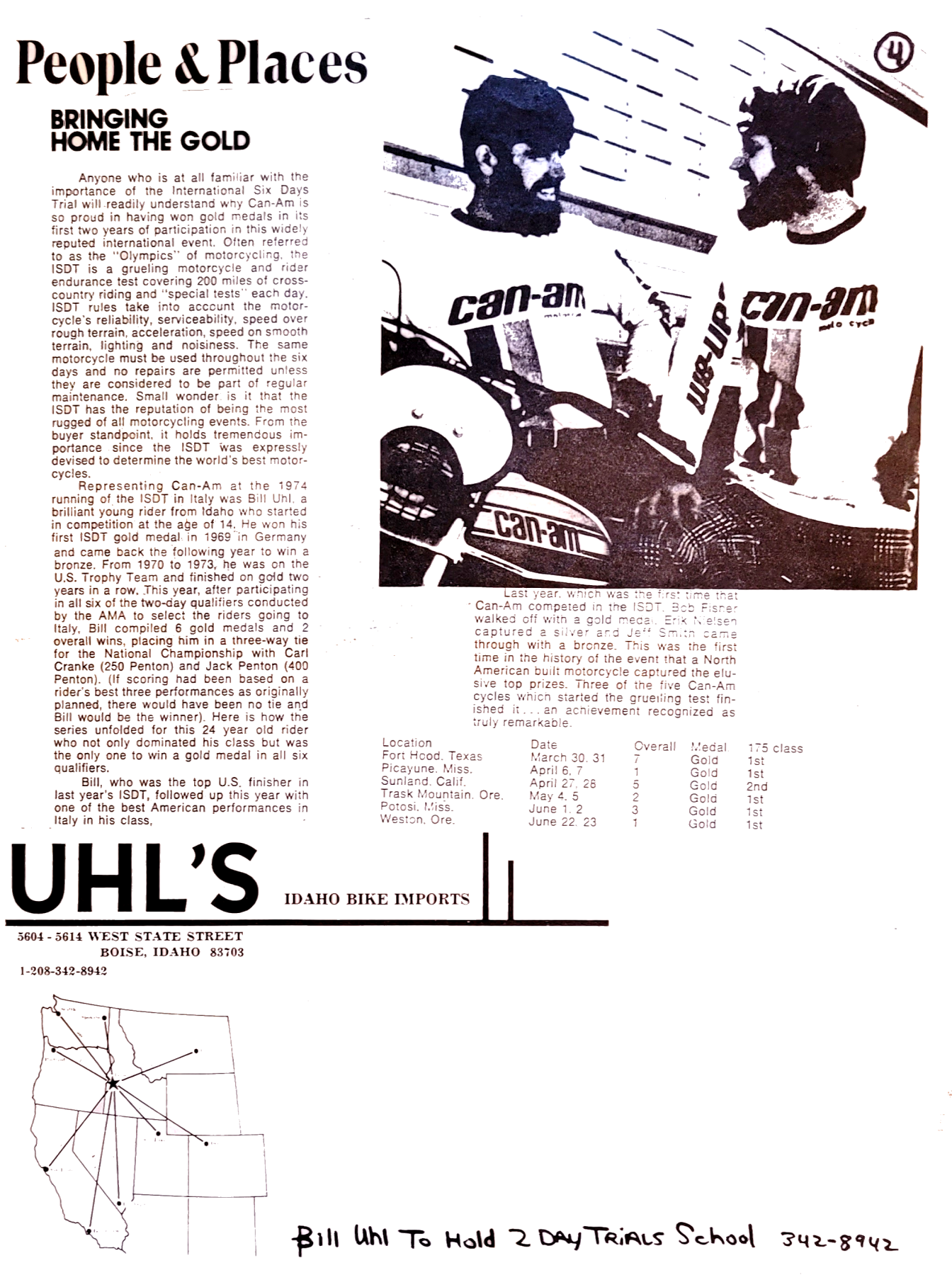
People & Places
Bringing Home the Gold
Anyone who is at all familiar with the importance of the International Six Days Trial will readily understand why Can-Am is so proud in having won gold medals in its first two years of participation in this wildly reputed international event. Often referred to as the “Olympics” of motorcycling, the ISDT is a grueling motorcycle and rider endurance test covering 200 miles of cross-country riding and “special tests” each day. ISDT rules take into account the motorcycle’s reliability, serviceability, speed over rough terrain, acceleration, speed on smooth terrain, lighting and noisiness. The same motorcycle must be used throughout the six days and no repairs are permitted unless they are considered to be part of regular maintenance. Small wonder is it that the ISDT has the reputation of being the most rugged of all motorcycling events. From the buyer standpoint, it holds tremendous importance since the ISDT was expressly devised to determine the world’s best motorcycles.
Representing Can-Am at the 1974 running on the ISDT in Italy was Bill Uhl, a brilliant young rider from Idaho who started in competition at the age of 14. He won his first ISDT gold medal in 1969 in Germany and came back the following year to win a bronze. From 1970 to 1973, he wason the U.S. Trophy Team and finished on gold two years in a row. This year, after participating in all six of the two-day qualifiers conducted by the AMA to select the riders going to Italy. Bill compiled 6 gold medals and 2 overall wins, placing him in a three-way tie for the National Championship with Carl Crank (250 Penton) and Jack Penton (400 Penton). (If scoring had been based on a rider’s best three performances, as originally planned, there would have been no tie and Bill would be the winner). Here is how the series unfolded for the 24 year old rider who not only dominated his class but was the only one to win a gold medal in all six qualifiers.
Bill, who was the top U.S. finisher in last year’s ISDT, followed up this year with one of the best American performances in Italy in his class.
Last year, which was the first time that Can-Am competed in the ISDT, Bob Fisher walked off with a gold medal, Erik Nielsen captured a silver, and Jeff Smith came through with a bronze. This was the first time in the history of the event that a North American built motorcycle captured the elusive top prizes. Three of the five Can-Am cycles which started the grueling test finished it… an achievement recognized as truly remarkable.
Location
Date
Overall
Medal
175 class
Fort Hood, Texas
March 30, 31
7
Gold
1st
Picayune, Miss.
April 6, 7
1
Gold
1st
Sunland, Calif.
April 27, 28
5
Gold
2nd
Trask Mountain, Ore.
May 4, 5
2
Gold
1st
Potosi, Miss.
June 1, 2
3
Gold
1st
Weston, Ore.
June 22, 23
1
Gold
1st
Bill Uhl to hold 2 Day Trials School: 342-8942
Uhl’s Idaho Bike Imports
5604 – 5614 West State Street, Boise, Idaho 83708
April 27, 1975
(4)
Where is Bill Uhl today? See OHV Training for more information.
Do you have a fantastic idea for an invention? That’s great news! Everyone has a special idea or invention that the world needs to see. Sharing your idea can make a big difference and help things move forward in a big way. It’s your sacred responsibility to share your ideas. If you do it right, you can also make a lot of money from it.
1. Document Your Idea
Start by writing down every detail about your invention, including how it works, its purpose, and how it’s different from existing products. Keep a dated inventor’s journal and have it signed by a witness. This documentation will be crucial when you seek help and protection for your idea.
2. Research and Protect Your Idea
Conduct a patent search to ensure your idea is unique. You can use resources like the U.S. Patent and Trademark Office (USPTO) website for this. Consider filing a provisional patent application to secure a filing date while you further develop your idea. This gives you a year to refine your invention and file a non-provisional patent application.
3. Create a Prototype
Develop a working prototype of your invention. This will help you test its functionality and make any necessary improvements.
4. Seek Professional Help
Consult with a patent attorney or a professional invention development company to guide you through the patent process and help you refine your idea. They can assist with preparing your patent application, including the written description, the claims, and the drawings.
5. Market Your Invention
Once your idea is protected, start marketing it. You can approach companies that buy invention ideas, such as Idea Buyer, Sharper Image, and Dewalt. You can also consider licensing your idea to a company or do-it-yourself manufacturing and marketing your product using crowdfunding resources.
6. Government Resources
Explore government grants and resources for innovation and entrepreneurship4. Local Small Business Development Centers (SBDCs) can provide guidance and support.
7. Online Platforms
Use online platforms and forums to connect with other inventors, get feedback, and find potential collaborators.
Getting help with your invention idea involves documenting your idea, conducting research, protecting it through patents, seeking professional help, and marketing your invention. By following these steps, you can turn your idea into a reality and make a significant impact.
You can always get a copy of my book, How to Make a Patent for an Idea, to help you even more with your invention idea. And if you’ve read my book and think you could use some subjective feedback on your invention idea, contact me.
In How to Make a Patent for an Idea: Survive the Invention Process, Help Humanity, and Make a Ton of Money, Herb Uhl, a practical inventor renowned for creating the first two-wheeled ATV, delivers an indispensable guide for aspiring inventors. At 95 years old, Uhl’s wealth of experience and passion for innovation shine through every page, making this #1 New Release book stand out in patenting and product development literature.
A Comprehensive Guide with a Unique Perspective
Its comprehensive and realistic approach sets Uhl’s book apart from others on the same topic. Uhl thoroughly explores various strategies for developing product ideas and engaging in advanced thinking processes. He helps readers determine whether the patent process suits their invention, offering the valuable insight that patenting isn’t always the best route. Instead, he introduces the option of bypassing the patent route to go straight to manufacturing and marketing. This approach emphasizes working smarter, not harder, to achieve financial success.
Encouraging Innovation and Overcoming Fear
One of the most inspiring aspects of Uhl’s book is his unwavering belief that everyone has a million-dollar idea capable of benefiting society. He urges readers not to let fear or self-doubt prevent them from sharing their ideas. Instead, he encourages proactive participation in the evolutionary process of innovation, emphasizing the importance of every idea as a link to future progress. Uhl’s motivational tone is infectious, instilling confidence and possibility in his readers.
Overcoming Subconscious Hurdles
Uhl’s straightforward writing style makes complex concepts accessible, ensuring readers can follow along without feeling overwhelmed. He addresses the subconscious hurdles that often prevent people from pursuing their inventive ideas, offering practical advice on building confidence and taking decisive action.
The Risks and Rewards of Patenting
While Uhl advocates protecting intellectual property, he also cautions inventors about potential pitfalls. He discusses how the patent process can sometimes backfire, leading to complications that may deter or financially burden inventors. Furthermore, he warns against the risks associated with bank financing and partnerships with organizations like the Small Business Administration (SBA), which may not always have the inventor’s best interests at heart.
The Revised Poor Man’s Patent
For those operating on a tight budget, Uhl introduces a revised version of the “poor man’s patent.” This method provides a cost-effective way for inventors to safeguard their ideas while they test the market.
Practical Advice for Market Success
Drawing from his extensive experience, Uhl shares valuable insights into successfully bringing a product to market. He emphasizes the importance of product sizing for optimal shelf display and efficient shipping and highlights the benefits of utilizing free packaging materials, reducing costs, and enhancing profitability.
Cautionary Tales and Actionable Advice
Uhl’s extensive experience is evident as he shares cautionary tales that cover all aspects of idea promotion, patenting, manufacturing, funding, and partnering. These stories serve as warnings and lessons, guiding readers through potential pitfalls with actionable advice. Uhl’s guidance is practical and grounded, making complex processes understandable and manageable for readers at any stage of their invention journey.
Experience the Fulfillment of Innovation
How to Make a Patent for an Idea is more than just a guide to the patenting process; it’s an invitation to experience the exhilaration and fulfillment of bringing an idea to market. Uhl’s wisdom, accumulated over a lifetime of inventing and repurposing, allows readers to significantly impact the world while achieving personal satisfaction and financial rewards. His concise, no-nonsense delivery ensures that readers can quickly grasp and apply the concepts, making this book a practical manual for anyone looking to successfully navigate the world of invention.
A Brief, No-Filler Approach
Uhl’s delivery is brief and to the point, stripping away unnecessary filler to focus on essential information. This approach ensures that readers can quickly grasp and apply the concepts, making the book a practical manual for inventors at any stage of their journey.
Conclusion
Herb Uhl’s How to Make a Patent for an Idea is a must-read for aspiring inventors. It combines practical advice with motivational guidance, making it an invaluable resource for those looking to turn their ideas into reality. Uhl’s passion for innovation and belief in every idea’s potential make this book an inspiring and practical tool for achieving success in the invention process. Whether you are a seasoned inventor or just starting, Uhl’s insights will help you navigate the complexities of patenting, manufacturing, and marketing your product, ultimately leading to personal and financial fulfillment.
Author Inventor Herb Uhl
Author: Herb Uhl
Herb Uhl, who pre-designed the Honda Trail 50 and is credited as the inventor of the two-wheeled ATV (All-Terrain Vehicle), has significantly impacted the motorcycle industry. His modification of Honda Cubs laid the groundwork for trail bikes, three-wheelers, and ATVs. Uhl’s “Smaller Adult Motorcycles: Long Awaited New Market Segment” proposes high-end motorcycles for shorter riders seeking quality rides. He taps into an untapped market segment, addressing motorcycle ergonomics for men and women of shorter stature 1.
Additionally, Uhl shares his story of creating the Honda Trail motorcycle, a pivotal moment in motorcycle industry history 2. His influence extends beyond inventions; it shapes how we ride today 3.
In summary, the book and Herb Uhl’s contributions offer valuable insights into patenting and motorcycle innovation. Whether you’re an inventor or a motorcycle enthusiast, their work is worth exploring.
In the annals of motorcycle history, few stories are as compelling as that of Herb Uhl, a visionary innovator from Boise, Idaho. Uhl’s story is a testament to the power of seeing potential innovation in an existing design and the transformative effects such vision can have on an industry1.
The Beginning
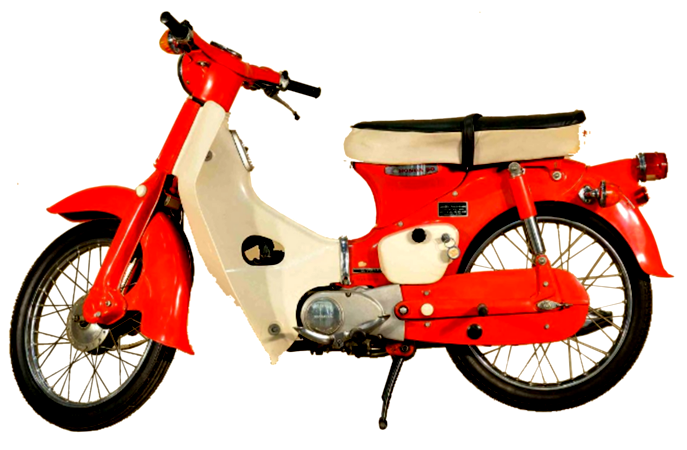
Herb Uhl was the first importer of a Honda motorcycle of any kind into the United States1. The Super Cub, known then as the C100 or CA100, was a scooter-like Honda with a pressed-steel frame powered by a 50-cc engine with a three-speed transmission and automatic clutch1. Despite its innovative design, Uhl struggled to sell the Super Cub in Boise1, Idaho because motorcycles were primarily used in the local mountains on the hundreds of trails and old mining roads in the area and seldom for city transportation because in 1960, Boise was still a small town.
The Vision
Rather than seeing the Super Cub as only a great little city transportation bike with little sales potential for locals, Uhl saw potential. He envisioned transforming the Super Cub into an all-terrain vehicle that could be used for hunting, trail riding, on the ranch, and on the open road1. This would have huge potential for the local market served by Herb Uhl’s Herco Engineering Co. dealership.
In his custom motorcycle shop, Uhl began modifying the bikes to his trail and ranch specifications1.
The Success
Uhl’s modifications were a hit. His sales escalated rapidly, culminating in a volume of Honda Cubs sold by Uhl that surpassed the combined sales of all dealers in the Los Angeles region. His success caught the attention of Honda, who visited Uhl to see what all the commotion was about1. Herb introduced them to his trail bike based on Honda’s Super Cub1. Impressed, Honda asked him for the specs and even took one of his bikes home to reverse engineer it1.
The Legacy
In no time, Honda had production models of the first motorcycle-derived ATV, and it was for sale in all Honda dealerships. The successive Trail 90 became the biggest-selling adventure bike in the world3. Despite his significant contribution, Uhl never saw a penny from his innovation1. But for Uhl, it wasn’t about the money. It was about making a contribution and making motorcycles better for the riders1. Plus, he could sell more bikes with less effort because Honda was building his design, which needed no additional modification to serve his clientele1.
According to Herb Uhl
One of my strengths is my ability to understand what the public wants in a specific product line. For instance, when I was a motorcycle dealer, I understood the customers wanted a trail bike and nothing good was available, so I made one by modifying an existing little city transportation bike, Honda’s Super Cub, transforming it into the first motorcycle-derived ATV, and that has led to a multimillion-dollar windfall for the major motorcycle manufacturers which has led to the four wheelers and side-by-sides of today.
I’m sure you remember that the Jeep was the first automotive-derived ATV and look how that has led to today’s super trucks.
Conclusion
Herb Uhl’s story10 is a powerful example of the impact a visionary can have on the world. His ability to see potential innovation in an existing design led to the creation of the Honda Trail 90, and the many ATV trail bikes, four-wheelers, side-by-sides, and adventure bikes that have followed. Uhl’s modifications transformed the motorcycle industry, and his improvements continue to be celebrated in the success of Honda’s new model trail bikes today4, 2. Visionaries like Uhl should indeed be honored for their contributions to the world1.
Note: During Uhl’s time in the motorcycle industry, his store was associated with 30 different motorcycle brands from 9 different countries in order to satisfy his customers’ desires.
I’m Herb Uhl, let’s start off in Boise Idaho. My wife at that time got hit by a car when she was riding her motorcycle and we got about 800 bucks for the damage. I fixed the motorcycle for a couple of hundred and the other five I put into the motorcycle business.
That was the start of the motorcycle business, 500 bucks. I opened my own dealership. I wanted off-road motorcycles because it was Boise Idaho, and very few people ever rode a motorcycle on the highway except to get to the hills in Boise Idaho at that time.
I wanted off-road motorcycles and so I took on Maico (m-a-i-c-o) and I they had Enduro motorcycles at that time. I know years later, Yamaha thinks they invented the name but Maico Enduros were available in 1955 – 56.
Herco h-e-r-c-o (Herb’s company) engineering was in Garden City, part of Boise. If you’re looking North it’s on the left. Simple as that.
I ordered a motorcycle, and I guess I sold a couple of them. Then the importer, Nicholas Gray, the importer at that time out of Detroit, came to see me, and he offered me motorcycles on consignment, which got me in the business. So, my total investment was $500.00.
You could ride from your house to the hills on a motorcycle without license plates. Nobody paid any attention. That’s what everybody did. Very seldom, anybody ever rode a motorcycle on the road. Well, there were a few road riders but not many.
There were a lot of dirt riders because the foothills were right there and so everybody went to the hills, and that was my interest too, I didn’t care about riding on the road. You can drive on the road, you don’t have to ride on it. And there were lots of old logging roads and old mining roads because there was a lot of mining that went on in that area. So, we explored all those old roads and rode in all kinds of places.
I ordered the first Hondas from Japan. In fact, I think I got the first Hondas that came into the U.S. A guy down in San Diego with the name of Sailor Maine also ordered about the same time. We both went into the motorcycle business.
They were actually off-road motorcycles. There was a little bitty article in Cycle World, I think at that time, that had a picture of this motorcycle. Honda, out of Japan, and everybody was wondering if the thing would be any good if it would be junk, or what it was?
It looked good to me, so I ordered a pair of them. I got them in and sold them almost instantly. I ordered more, and they wouldn’t sell me anymore because they weren’t serious motorcycles. Those were built in their race shop, and they didn’t realize that that’s what we wanted. They didn’t get the message for several years. They couldn’t understand it because we wanted motorcycles for off-road use.
When they moved to Los Angeles and set up American Honda, I was the first American dealer to contact them. That was when they were in an apartment house out on Sepulveda Boulevard. They were trying to figure out how to set up a distributorship in America. They were up in this big apartment in the apartment house.
The first bikes I got, I forget what the model was, but it wasn’t a series model. As I said, it was special. Then they came out with the CB 71, 72, and of course, the C-100, the Honda Cub. That was a little 50cc, and so as soon as they got set up on Sepulveda with American Honda in their little building front, I went down to see him. I ordered some of the Cubs and they had a little 150 as well, so I ordered some of those 150s, a couple of them, and ordered a couple of CB-72s and two or three Cubs. When they came in at Boise, I looked at those Cubs and wondered how I was ever going to sell them in Boise.
That’s when I started looking at them as, what I could do to them to make them so that people would want them. I got to looking at them and every time I walked by them, I looked down a little more and I decided that they would make a way better trail bike than the tote goats and so forth that people were using at that time.
There was a guy in Boise that built sprockets and had a machine to make sprockets. I ordered a sprocket to stick over the other one as an overlay. Then I ordered knobby tires for them because that would be necessary. It took several months for knobbies to come in for it.
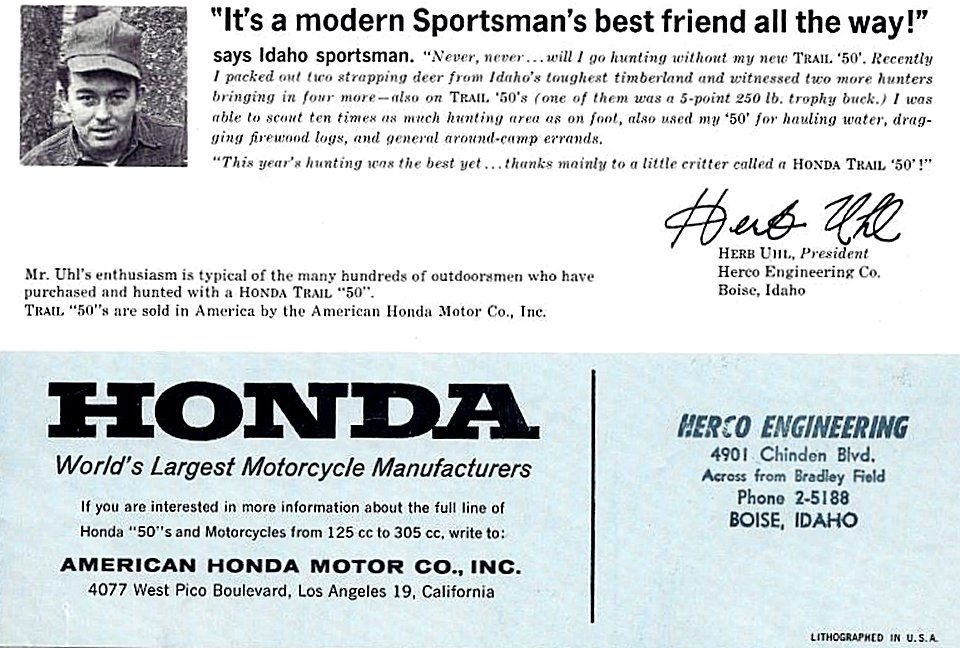
I tried it out in the hills and found out that it actually worked really well, so I started building them and ordered them in. I guess I sold several hundred of them before Honda noticed that I was selling way more Honda Cubs than all of their dealers in the Greater Los Angeles area together. And these were city bikes, where they should have sold there but here I was selling them out in a little town in Idaho.
Jack McCormick from American Honda called and wondered what I was doing to sell all those little cubs because they weren’t moving. I told him to make them into trail bikes and so he said, “Send me one of them, so I can see what you’re doing.”
I sent it to him and he looked it over. They rode it around and played with it. Then they sent it on to Japan and told Japan that they wanted the exact same thing as a separate model. That was the start of the Honda Trail Bike. Of course, once Honda started building them, then all the other motorcycle companies copied Honda, and there was trail bike Yamaha, and Kawasaki, and everybody had a little trail bike of some kind. That started the ATV motorcycle business.
I was just selling motorcycles. It was just the way things were, you know, I was just selling lots of motorcycles.
(It didn’t bother you that they took your designs and made their own bike?)
No, really because it didn’t even occur to me that it was a big deal but that actually started the motorcycle-derived ATV. And that’s made the motorcycle companies more money than anything else that’s ever been done to motorcycles. That’s where it started, then the three-wheelers came, and from that then four-wheelers, and now side by sides.
In fact, if it wasn’t for that (Uhl’s trail bike design) the side-by-sides would probably say Chevy, Ford, and RAM instead of Kawasaki or Yamaha. So, that really started the off-road motorcycle business.
Getting to a little lake or something up in the mountains required a horse or a hell of a long walk. They were building little scooters with Briggs and Stratton engines on them with no suspension on either end so that they could go up into those places. They called those things “tote goats” which became a brand the company started up to build those little things. They had a piece of plywood on there with a little padding on it and covering for a seat and so forth.
I looked at that Cub and I said, “This will do a better job than that.” it was simple. Really, really simple. It was just looking at it and seeing another use for this piece of equipment that nobody was covering. There wasn’t anybody covering a proper trail bike, so I built a proper trail bike. Just by modifying that Cub and that’s all that was.
Honda never really understood the trail bike. They still don’t. And that you can tell by what they’ve done. In the first place, they didn’t realize that the seat height on the Cub had a lot to do with its appeal. The first thing they did when they designed their own, after copying mine, was to raise the seat height by about three or four inches. So, they never understood it.
They did finally understand that. Somebody told them they needed a high and low-range gearbox and they did that but they dropped it. That was the only thing that they contributed to the trail bike that really improved it, was a high/low-range gearbox.
This new one doesn’t have it. So, the new one is not a good road bike or a good trail bike. It’s neither one. What it is, is an off-road fun bike. That’s all it is. But if they’d left the high low-range gearbox in it, it would be a really good trail bike.
I made a bigger sprocket because it needed to have a lower range of gearing. I made a big sprocket that slipped on over the original and that made it a high/low-range gearing so that it could be used on the trail and that’s the way we sold them. If they wanted to use them on the road, they simply slip that sprocket off and put the chain down on the original sprocket and away you’d go. That was the main thing.
Then they had a leg shield on it and I took all that off. I took their bigger muffler off and put on a small pipe, again for clearance, and so forth. I moved the shock. The shock had to be moved at the top of the shock to give room for the sprocket to clear. I simply did that, moved the bottom of the shock out to the outside of the swing arm instead of the inside, and that gave clearance. Really, that’s all I had to do. And added the knobby tires.
They already had the trail bike. It was already in that design. They just didn’t know it.
The feedback I got from my customers was the best you can get. They were loving it and they and their friends were coming in and buying them too. Now that’s the best feedback you can get.
Special thanks to Callum Blackmore, Eric Stoothoff, and Adam Bale for helping to get the word out. Maybe someday, someone will make an even better trail bike.
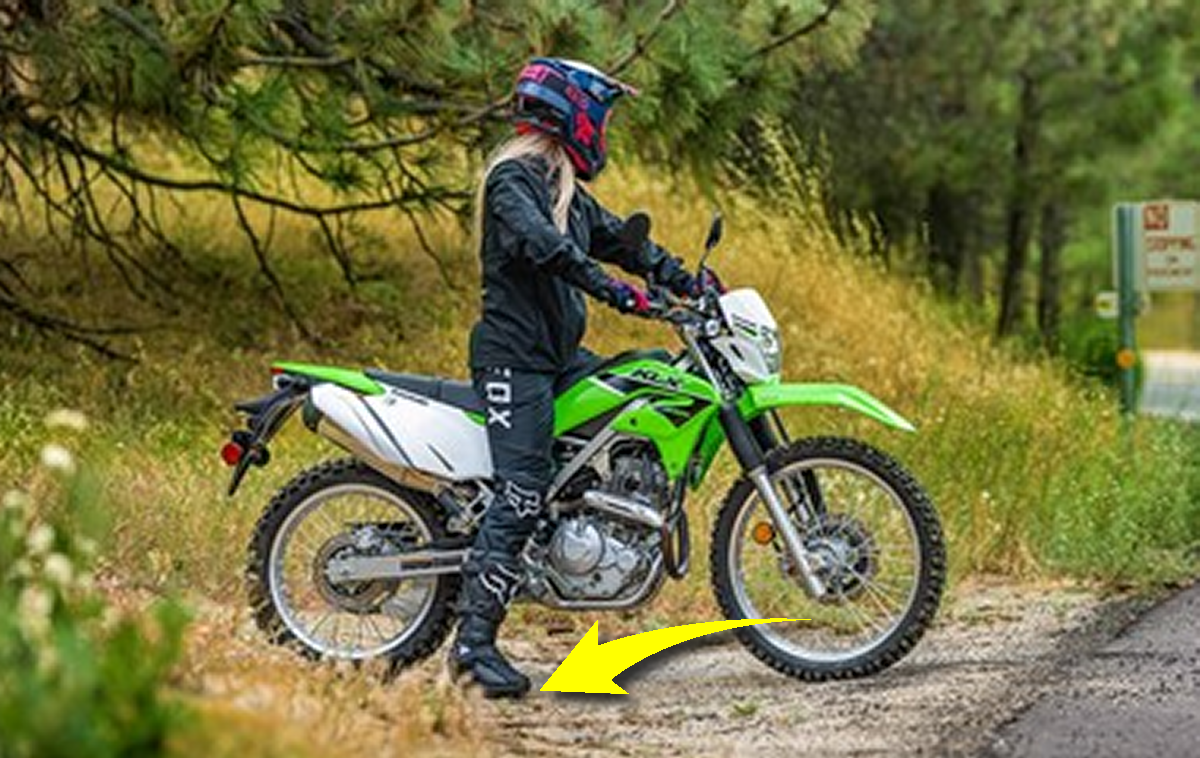
I was chatting with a friend about how Kawasaki has been the first motorcycle manufacturer to pay any attention to the short inseam off-road riders with their KLX230 S. (See: 3 Cheers for Kawasaki.)
That move could almost double their possible customers because most ladies and a tremendous number of men have inseams that range from 29 inches down to 26 inches.
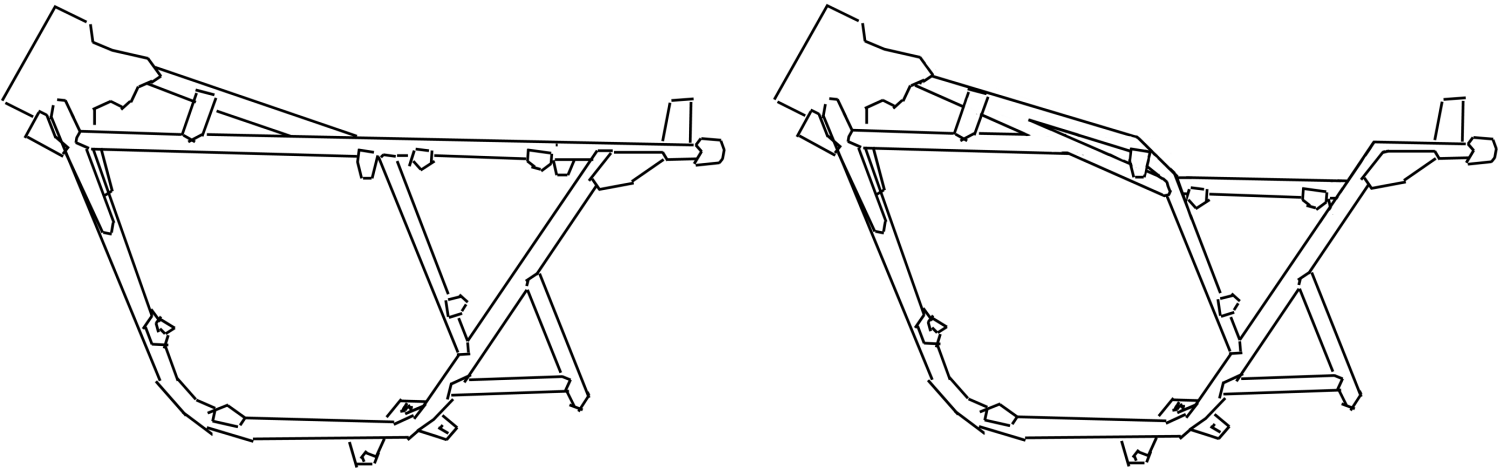
I was mentioning that Kawasaki could redesign and make a dedicated frame for motorcycles designed for smaller adults so they could have a plush 28-inch seat height.
His next remark astounded me!
He said, “But they need all the ground clearance they have now.”
So, I replied, “What does that have to do with lowering the seat?”
I thought everyone realized that there is only one basic measurement on a motorcycle that is fixed, and all the rest can be juggled to fit the type of motorcycle you intend to build, and that measurement is your desired ground clearance.
In other words, you can design the top part of the frame to give you the seat height you need and still have the necessary ground clearance.
The example on the left is the current fixed design. Right modified for short inseam seat height.
To put it another way; the height of the seat has nothing to do with ground clearance if the upper part of the frame is designed correctly.
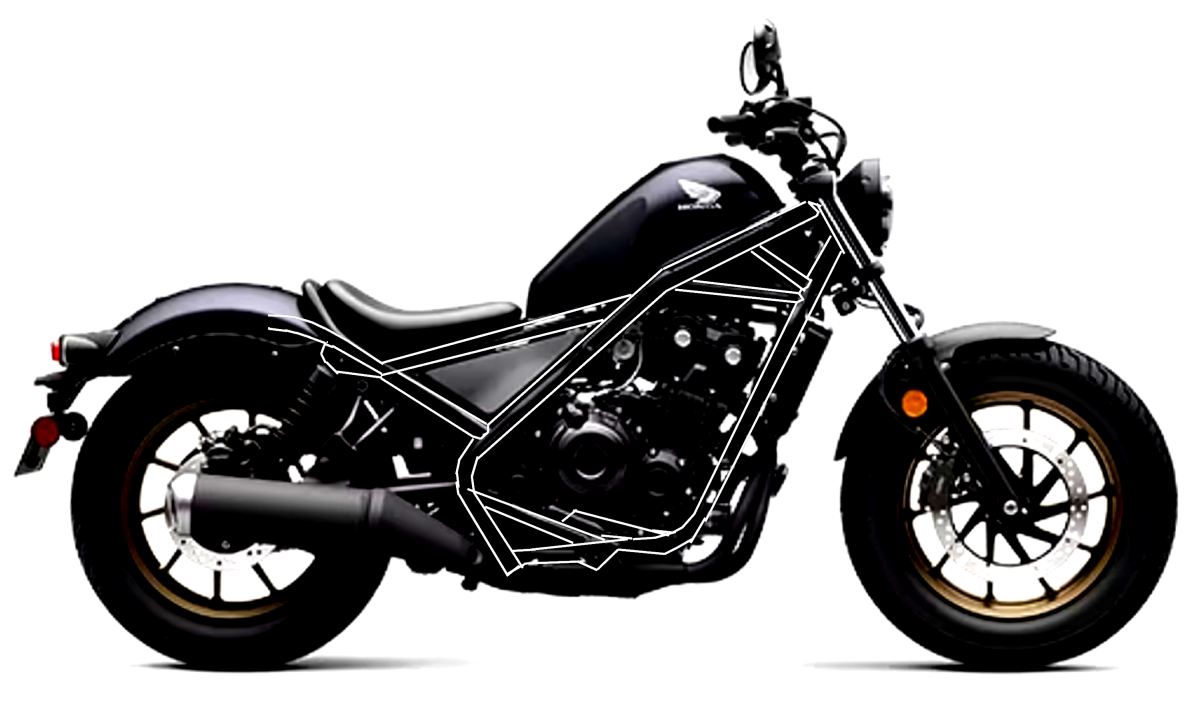
A good example of proper frame design for a low seat height is the Honda Rebel line.
With a very few modifications, the Rebels could be converted into proper adventure bikes for short inseam people.
Now the question is,
Will Honda make those modifications or will someone else have to do it?
Right, now, there are no adventure bikes available to roughly one-half of the world population. Most ladies and millions of short inseam men.
Currently, the most wanted style of motorcycle is the adventure bike! It is a sort of go anywhere kind of motorcycle, just like the SUV is a kind of go anywhere car.
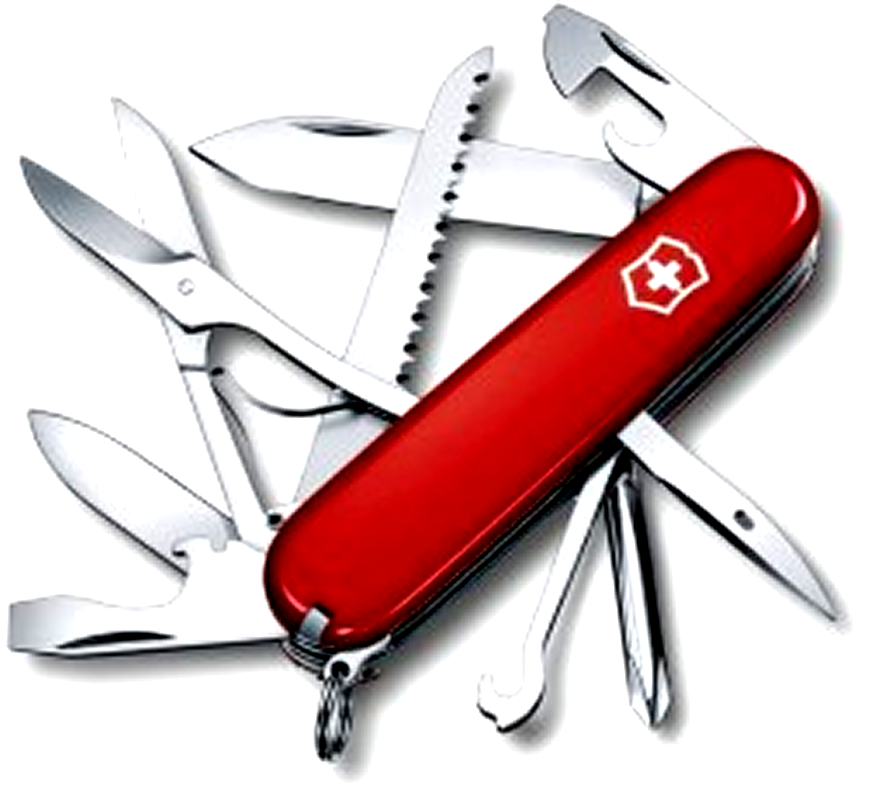
The Swiss actually started it all with the Swiss Army Knife. Now everyone only wants to invest in a product that will do many tasks well and I don’t blame them.
Getting back to the adventure bike; only about one half of the population who want one could safely ride the models that are actually available because the seats are too tall for their short inseams.
It is just not safe to only be able to touch one toe on the street when you have to stop for a light.
Honda could easily fill that gap in the marketplace with adventure bike modifications to their Rebel line of bikes.
Herb Uhl started with the Honda 50 Cub as the base
Uhl’s Cub modifications created the best trail bike
It is almost like it was back in the 1960s. Honda had this slick little city commuter bike called the Cub with independent front suspension, but they really had nothing the average American wanted to help make use of the outdoors.
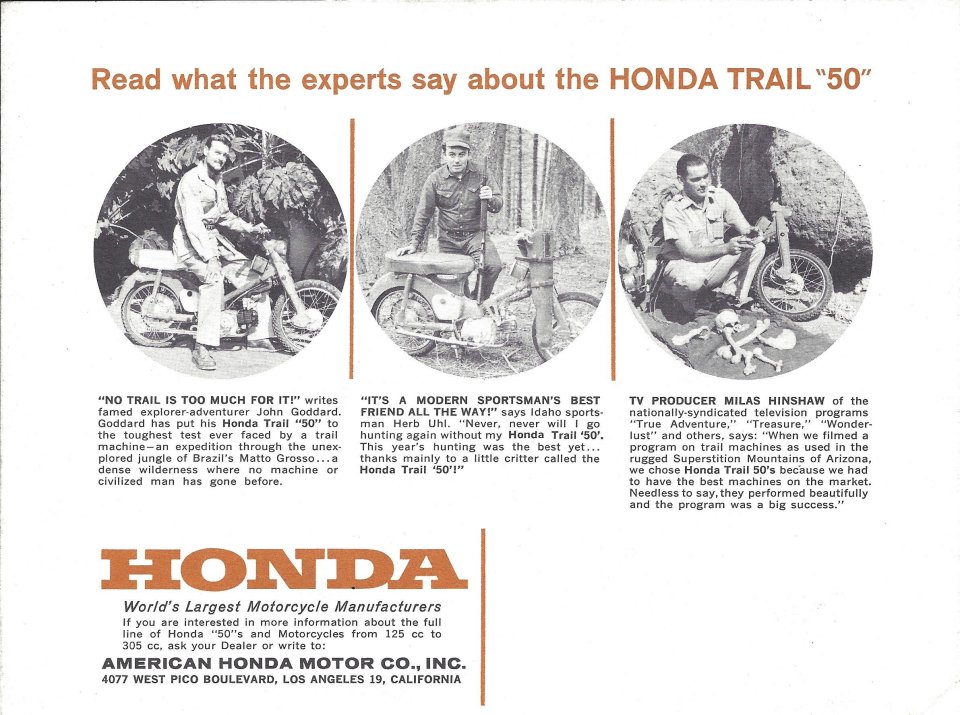
Herb Uhl (center) featured in Honda promotional materials
I was a Honda dealer at that time, and I saw a possible trail & ranch bike lurking in that Honda Cub design. I ordered a few special parts, made some parts, and had others made, and just like that, we had the best trail bike available anywhere in the world.
The Honda Rebel line is in the same state now.
The frame is correct. It simply needs spoke wheels with a 21-inch front, an independent front suspension because they don’t need excessive travel for the good ride, electronic controlled shocks, and a larger gas tank.
With those few changes, Honda would be amazed at the people waiting in line for such a bike.
 WHY THIS MATTERS NOW
 Visit the AMA Motorcycle Hall of Fame website →
 YOU CAN MAKE YOUR VOICE MATTER
 The Best Adventure Bike: How to Own the Best Adventure Bike Now